
Legend of Korra
Book 1: Air, Chapter 1
(Check the series page for preamble. We’re jumping right in here.)
We open on the usual bending showcase, now starting the cycle with earth as well as distinctly showing the four most recent Avatars: Kyoshi, Roku, an adult Aang, and finally Korra. This is followed by some narration. Like the previous show, it’s a way for the writers to sit with the viewer and briefly communicate the current landscape and state of affairs in this world without breaking the fourth wall. The first show did this very succinctly, to the point where a shortened version of it ended up becoming the intro for the series: The world is devastated by war with the Fire Nation, and the Avatar is its only hope. We’re clear on who we’ll be rooting for, and who will be the enemy. There is one being in this universe with the power to end the destructive conflict, and so our investment is tied to one girl’s hope that he’ll return.
So after three seasons chronicling this story, beginning with the Avatar’s return and ending with the Fire Nation’s defeat, Legend of Korra’s opening will be massively important in terms of continuing this universe. Let’s see how they did.
It’s been 70 years since the end of the Hundred Year War. In that time, Avatar Aang and Fire Lord Zuko coalesced the former Fire Nation colonies into the United Republic of Nations, a haven where people, regardless of bending or culture can live together in peace. Though Aang’s time has passed, the Avatar cycle begins anew. And this is where our story begins.
The biggest contrast to the setting of Avatar is that Korra, rather than using a war as a framing device, mainly takes place during peacetime. There isn’t quite a single pressing need for the Avatar in this world. This will allow most of the action to remain localized in one place season to season rather than taking us on a journey around the world. And Korra will be dealing with individual threats one at a time rather than the original show’s overarching goal of facing the Fire Lord. These aren’t problems, by the way. I’m merely highlighting the new direction this show will be going, which can be refreshing or frustrating depending on how attached you are to the other show’s structure. There are benefits and drawbacks to both, so we’ll just have to see how Korra does. It’s all in the execution, baby.
We can talk about Republic City as a setting when we get there. Right now, our story has begun proper. Whatever it has to offer, I think I’m going to be able to get through it real quick. I won’t get hung up on every last scene, every last word of dialogue. Nope. It’s gonna be smooth sailing from here folks.
We open on some representatives of the White Lotus making their way to a dimly lit home in the Southern Water Tribe. The owner of the home greets them at the door, thanking them for gracing their home with their presence. Inside, the man’s wife, who’s been clearly tidying up in preparation for their arrival, welcomes them and tells them that they should be happy to know their “search” has come to an end. The White Lotus, tired and weary from having investigated false claims in both the Southern and Northern water tribes, are skeptical that their daughter is “the one.“
Enter a toddler-aged Korra who earthbends a wall open and showcases her bending.
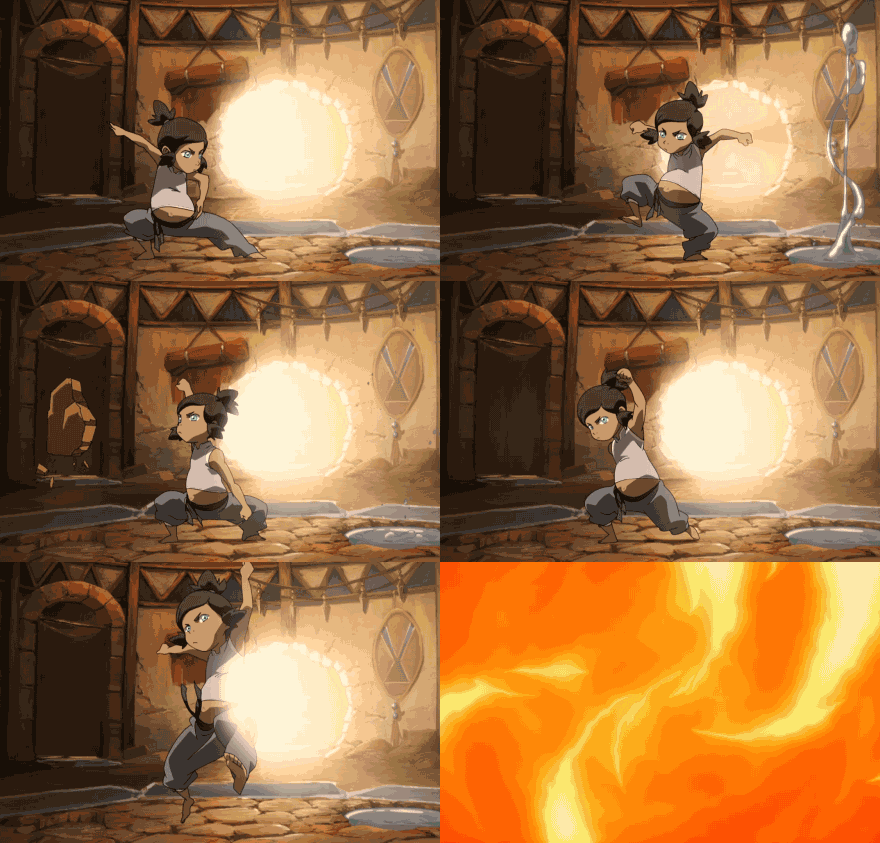
[Korra] I’m the Avatar! You gotta deal with it!
Alright, stop.
I’m not mad, okay? I’m not mad. I haven’t even used a swear word yet.
But I need you guys to absorb what’s just happened here.
This is our introduction to Korra. She’s about four years old here, and she’s shown to have a mastery of water, earth, and firebending. This scene right here is emblematic of the show’s approach to the writing for its main character and its worldbuilding, particularly in regards to bending.
Let’s talk about the latter first. It’s not the first time it’s come up in coverage of this series, and it certainly won’t be the last.
This would be the first of many, many instances of The Legend of Korra trivializing bending as a discipline. Whereas the first series established the bending system as a martial art, requiring a level of skill and training, it is regularly shown in this series to require neither. Right from the start, we’re bursting the floodgates wide open by showing the audience that a toddler can do it with ease. It would make sense that Korra, being the Avatar, would have a natural affinity for the different types of bending. But this level of proficiency requires time worth of training that this baby just did not have. Aang was the youngest airbending prodigy in his day and even he didn’t earn that title until the age of twelve. And that was while under the tutelage and guardianship of an airbending master. He had no idea he even had the ability to bend anything else until he was told he was the Avatar at twelve. Over the course of the series, he shows an aptitude for waterbending, a reluctant affinity for firebending, and earthbending is crapshoot until he gets the hang of it. With the pressure of having the learn the elements in only a few months before Sozin’s Comet, Aang has varied levels of proficiency at the four types of bending when it comes time to actually face him. This is also tied to his character, being a kid who mostly rode on his raw talent and didn’t take training all that seriously.
This brings us to the character side of things for this bit. Korra has only one line of dialogue here:
[Korra] I’m the Avatar! You gotta deal with it!
This tells us Korra is fiery, loud, outspoken, and proud of being the Avatar. In direct contrast to Aang, who never wanted to be the Avatar, Korra has practically staked her identity on it. What’s more is that Aang was told he was the Avatar well before the traditional age of sixteen because the elder monks saw war on the horizon and thought Aang ought to start his training early. Korra’s obviously found out at a fraction of Aang’s age…during peace time.
Uh huh.
It also tells us that Korra is very much a “get down or lay down” type of person, and she’s more than happy to use her status as the Avatar to get her way. This is something that carries through for much of the season…actually for much of the series. I want you to keep this single line of dialogue in mind because I’m going to argue now that Korra never actually fully outgrows this mindset.
It all can be summed up in this one gif. This is the writers communicating that they will not be putting in the same sort of legwork this time around. We are skipping the Avatar journey and Korra is not going to be challenged in that regard. We’re beginning the series with three out of the four elements in the bag. So then, the main conceit of this season is she will be learning air, with the main hurdle being her struggle with the “spiritual side” of bending. Do they at least resolve this in a satisfying way?
Uhh…let’s just carry on and see where the season takes us.
So yeah, this scene can be incredibly frustrating to watch. But you know what the worst thing about it is? It isn’t even necessary.
The purpose of this scene is to establish Korra as having mastered 3/4 of the elements prior to the start of the series. It’s created a number of plot, character, and world issues as we’ve just went over. But then we hard cut to Korra at age 17, practicing with firebenders as part of a training regimen…providing a perfectly serviceable explanation for why Korra’s mastered 3/4 of the elements prior to the start of the series. We could easily cut the baby scene and lose nothing, but the writers clearly wanted to establish Korra right away to be as different as possible from Aang. And to do this, they decided to show an adorably precocious Korra who could bend straight out of the womb without thinking of the implications. Oh well.
For those new, yes I did just spend all those paragraphs picking apart a 30-second scene. Welcome to my blog!
So Korra is dominating against her sparmates during her firebending test. The White Lotus watch her and among them is a much older Katara(!), now a member of the order.
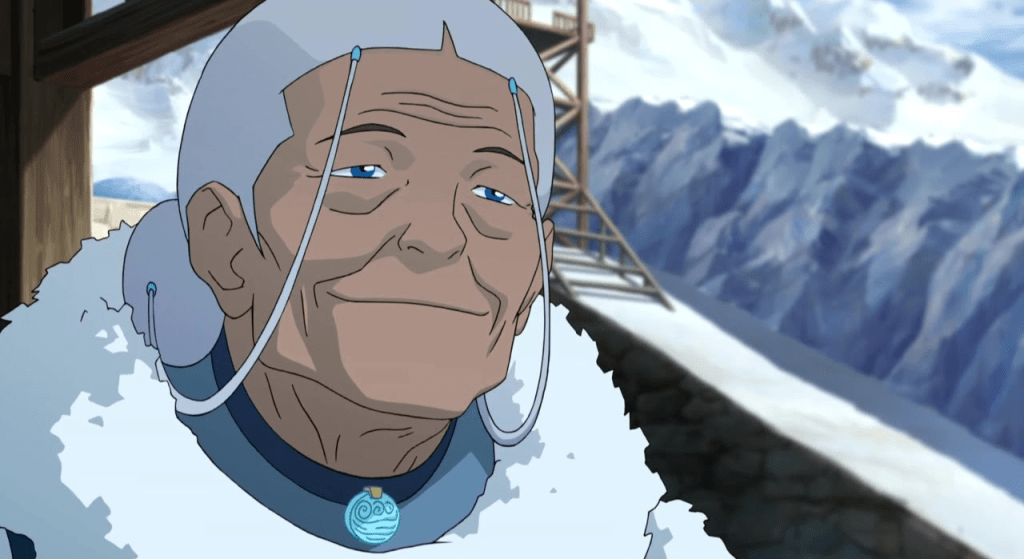
She remarks on how strong Korra is. The more gruff leader says in response that “she lacks restraint.” Upon completing her test, Korra celebrates but the leader tells her,
[White Lotus leader] Ever since you were a little girl, you’ve excelled at the physical side of bending, but completely ignored the spiritual side. The Avatar must master both.
The viewer is almost primed to side against the leader because he’s antagonistic towards our main character, and he’s also poised against Katara, a familiar character the viewer can latch onto. But the reality is that Korra’s been trained in this compound since she was a little girl, and the White Lotus, presumably, would have been responsible for determining her curriculum. So the leader has very little room to make these criticisms of her. Her firebending test, from what we see of it, involves fighting two other firebenders and little else. It’s pretty much all physical. If Korra lacks aptitude outside of the “physical” side of bending, that’s entirely the White Lotus’ fault. She’s practically been set up to fail. It was my understanding that the Avatar was meant to travel the world while learning the four types of bending. If there’s anything non-physical to appreciate, I imagine it would come from the Avatar journey, but we’re not getting that in this series. So it’s almost like the writers have set her up to fail. And why is the White Lotus leader reluctant to advance Korra to airbending when it’s understood by everyone that that practice is mostly spiritual? Korra herself says that it isn’t something she’s ignored, it just doesn’t come as easy to her. So wouldn’t giving her training in airbending be the next logical step, since she’s pretty much mastered the other three already? We don’t get a clear idea of what exactly has Korra failed to grasp beyond these vague terms. What does the spiritual side of bending refer to, anyway? Is it the mindsets and culture behind each type of bending, as explored in “Bitter Work”? Well, so far Korra definitely has the passion of a firebender, the willfulness of an earthbender, and the adaptability of…
Hang on.
Why is airbending the element Korra has trouble learning?
Walk with me here. Aang had trouble with earthbending because it was opposite to his native element, so shouldn’t Korra struggle with firebending, being a native waterbender? The easy answer to this would be that Korra’s fiery personality lends perfectly well to firebending. But if personality is the main factor…shouldn’t Korra struggle with waterbending, being that waterbending is about fluidity and grace? Water and air are not too far from each other, hence why Aang adapted to it fairly quickly. Air is the element of freedom and I don’t think it’d be too difficult to describe Korra as a free spirit. The more I think about it, it’s change that Korra regularly struggles to cope with. To put it in perspective, Korra is a native waterbender who has no trouble with fire, her natural opposite, to the point of excelling at and favoring it over the rest. Instead, she has trouble with air…the natural opposite of earth. Now mind, I’m not saying it’s a strict contradiction that Korra would have trouble with airbending, but the show pretty much takes for granted that she’s got the other three down pat and doesn’t interrogate this premise any further. Did she learn them in order…as a toddler?
Do you see the Pandora’s Box of issues that baby scene creates?
The reason for this is meta, and it’s the same reason we’re not doing the Avatar journey this time around: it would be too similar to the previous series. Airbending is the only element left in the franchise we haven’t seen someone learn, after all. We still don’t know what airbender training looks like. To show Korra mastering the other three would get in the way of that, so we need her situation to be an inverse of Aang’s. And hey! This way we get to keep in line with the naming convention of the previous three seasons. We don’t want to re-tread old ground and just do what the other show did, do we?
Well this here is what we in the business call a faulty premise, because Avatar wasn’t just about Aang learning the elements. There was a war on top of it, necessitating that he learn them faster than any previous Avatar. This provided a backdrop to tell many stories, with the quest to master the elements providing an excuse to travel the world so thoroughly. It’s what took the group to the siege of the North, uncovering the conspiracy of Ba Sing Se, taking those field trips with Zuko, and many other celebrated stories and arcs throughout the show. The lessons themselves only consisted of about 10% of the overall story (and even that I think is generous). Why exactly is the assumption that we could only have a repeat of Avatar rather than a new story with new characters and new settings? Why is the assumption that the iconic bending lessons won’t be missed because they’ve been done already? Were they not an interesting part of the original show? Is there no more room to elaborate on them, especially given how much might have changed in the past 70 years? Have we ever gotten a story about an Avatar having difficulty learning their own native element? I don’t think so.
But maybe I’m getting ahead of myself. Let’s just see what they do with the story we got.
Katara gives the go-ahead to move Korra to learn airbending with Tenzin. No one else says anything so this is seemingly a unanimous vote in Korra’s favor(?) Korra goes to tell the good news to her polar bear dog, Naga. It’s here we get to meet Korra’s animal guide, just as Appa was to Aang and Fang the dragon was to Roku…which is neat! What’s notable is that Korra has to get permission from a White Lotus member to take Naga for a stroll, assuring him that she “won’t go too far.” For some reason, Korra is kept on a rather tight leash around the compound. Why that is something we’ll get answers to much later.
What comes next is the arrival of Tenzin, Katara and Aang’s youngest son. He has a family of his own; his three children Jinora, Ikki, and Meelo, and his pregnant wife Pema.
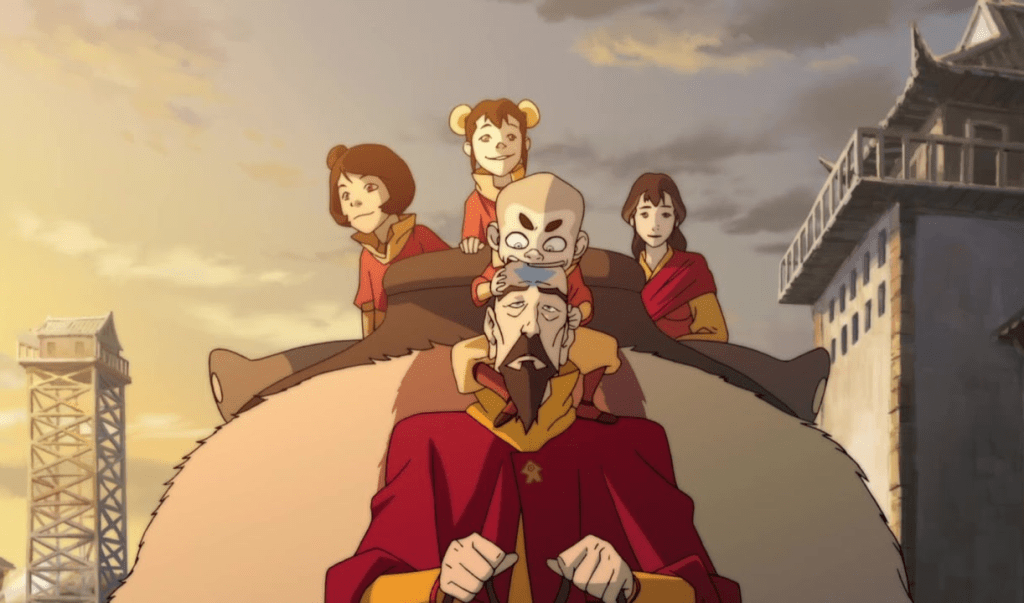
Tenzin is immediately sympathetic to the viewer as a tired dad taking his children on a trip, while taking extra care to dote on his pregnant wife. But then we see the kids descend down the bison on air scooters and it’s hard not to feel a surge of catharsis. We now know that this little family represents hope for the future of the Air Nomad culture. Aang in the original series was the last remaining airbender after Fire Lord Sozin called for the genocide of all the airbenders to begin the war. This was near-permanent damage left by the Fire Nation that would remain even after the end of war. A scar left on the world that would take hundreds of years to heal. To know that this screencap represents the entire airbending population is a sobering reminder of this. But to know Aang had one airbender child who went on to have three (potentially four) airbending children of his own also presents a comforting prospect that the Air Nomads could rise back to prominence someday. It’s a small step, but the first step towards healing often is, a theme that was prevalent in the previous show.
Now all that is beautiful. It really shows that…
Wait a damn minute.
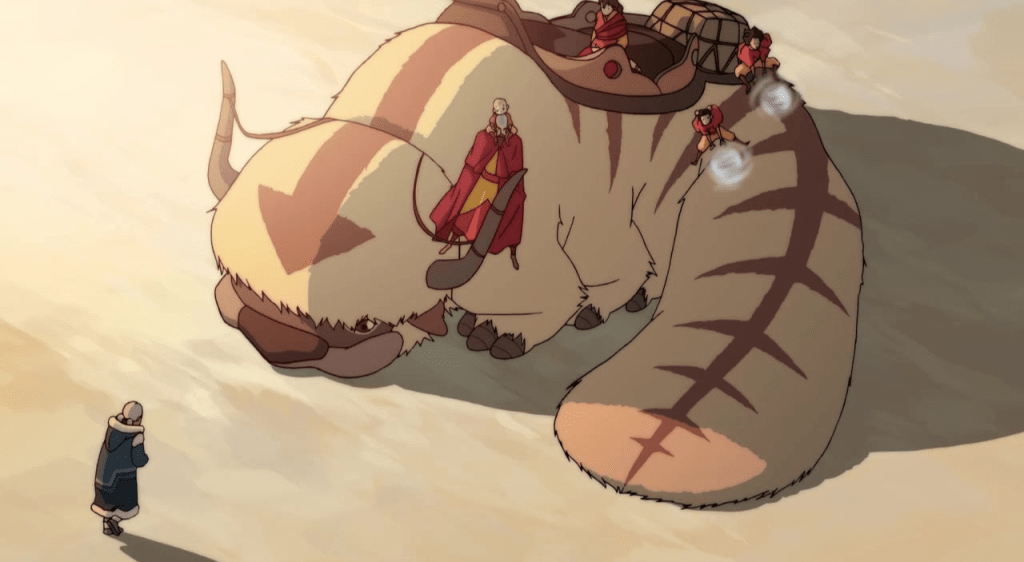
“Right. And this is Katara, my flying sister.”
What fresh hell is this, Bryke? An honest-to-God sky bison, thought to have gone extinct with the exception of Appa? What gives? Aang, Appa, and Momo were the last living members of the Air Nation. The tragedy lied in that they were all each other had. Appa in particular was the only living part of Aang’s old life besides Bumi. It’s part of what made the arc where he went missing in Book 2 so compelling. Any viewer would naturally feel confused why this one is presented so casually and might wonder where in the hell it came from…and we don’t get an answer.
🤓☝️ “Yes we do! The creators revealed at San Diego Comic Con that Aang found a healthy herd of flying bison some time after the war!”
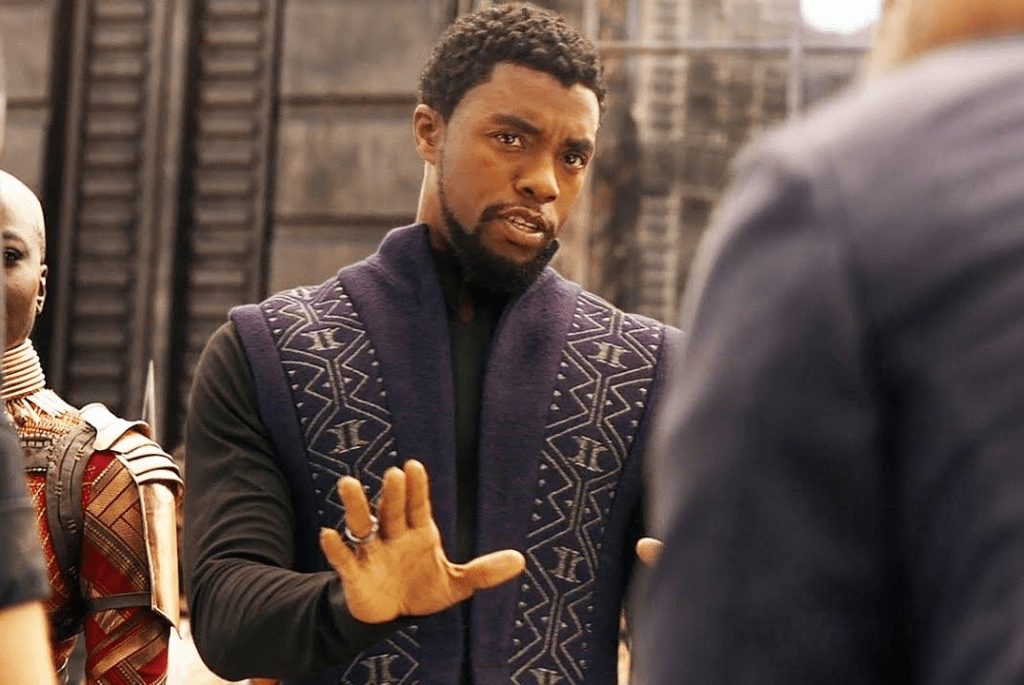
We don’t use information from third-party material here. No books, or comics, or confirmed-on-Twitter tidbits. This is because a piece of work should stand on its own. I’m of the opinion that incomplete work isn’t really something we should accept, let alone praise. You shouldn’t have to consume material outside of X to understand X. But even if we ignore all that, this “explanation” doesn’t really explain much at all. Without it, we’re left to assume that Team Avatar just found new bison somehow for some reason. Turns out the real reason is…they just found new bison somehow for some reason. Which is lame. It’s cheap writing, employed here because the writers wanted more sky bison. Simple as. As we’re about to learn, airships now exist as a form of non-combative transportation in this world (not to mention telephones), so it’s not like there was no other option. But sky bison are iconic and just as useful as a writing tool. It’s just a shame about the utter lack of restraint here compared to the quiet show of respect to the Air Nomad Genocide that was just demonstrated.
Anyway, there’s some nice character building here. Jinora and Ikki call Katara “Gran-Gran”, much like she called her own grandmother. Meelo calls her a “strange woman”, indicating he was born some time after the last time Tenzin visited. Katara predicts Pema’s baby will be another airbender and Pema says she wishes for just one non-bender in the family, like herself. Katara even indulges in a bit of teasing at Tenzin’s expense, saying he was always more “serious” compared to his older siblings, Kya and Bumi. It’s nice to see the character hasn’t lost her fun side in her age. It’s all organic means of conveying information to the viewer.
Jinora tells Katara that she’s been reading up on all her old adventures, and asks one burning question she has left: What happened to Zuko’s mom? Before Katara can explain, Ikki interrupts by motor-mouthing a bunch of frivolous questions, much to the disappointment of Jinora…and the audience. This is very clearly a joke made at the expense of fans who would also be curious about the fate of Zuko’s mother, as it was conspicuously left unanswered at the end of the original series. You may find it funny, or you may not. However, if there are chronicles of the Gaang’s adventures that Jinora’s read, wouldn’t she already know what happened to Zuko’s mom? We eventually got (rather ridiculous) answers to the question in the form of a comic book miniseries. Isn’t there a copy of “The Search” for Jinora to read? Why would the chronicles arbitrarily stop after the end of the war? Could it be because that’s where the television series ended? Hmmmm…
Jokes are hard to talk about here because I can’t tell you what you’ll find funny. But jokes can be broken down to their components and can be assessed on how tenable the information is when put together. This joke is a double thumbs-down because it’s a middle finger to the audience, and doesn’t make sense anyway. It’s arguably a triple thumbs-down because the comic it’s pretty much advertising here sucks balls!
But moving on.
Tenzin sees Korra, who tells him how excited she is to learn airbending. Tenzin breaks the bad news that Korra’s airbending training will have to wait. He’s staying the night before heading back to Republic City, as he’s needed there.
Tenzin…ferried his entire family, including his very pregnant wife…all the way to the South Pole…to tell Korra he can’t stay at the South Pole.
Right.
As I indicated earlier, the Avatar world has radio now, so why not just call? Why take the long arduous journey by sky bison if the situation in Republic City is so “unstable”, as Tenzin puts it, that he needs to be there first and foremost?
Well, I’ll tell you why. The writers wanted to introduce us to Tenzin and his family, and so needed to write a way for him to ferry everyone halfway around the world, and so they invented more sky bison. What a clumsily-supported scene this turned out to be.
Korra presents the idea of travelling to Republic City with Tenzin if he can’t stay at the compound, but the White Lotus leader from before shoots her down, saying the city is “too dangerous” and that it would go against Aang’s order to keep the next Avatar safe. Korra counters that she’s being kept like a prisoner in the compound and that Tenzin is her only option, being the only airbending master in the world. The elders get the final word, though, and she storms out. As she watches Tenzin leave the next morning, Korra becomes resolute and determined. She decides that night to leave the South Pole for Republic City herself.
As she’s packing to leave, Katara catches her. What follows is a touching scene and one of the few in this show I would describe as pitch-perfect. Korra tells Katara she needs to find her own way as the Avatar. Katara is understanding, having been in the exact same position the fateful day she and her brother decided to leave their tribe and travel the world with Aang. She knows when the call of destiny compels you to leave what’s familiar and chase the unknown. She somberly says that Aang, Sokka, and many of her friends are gone, and it’s time for Korra’s generation to take up the torch and carry on protecting peace and balance in the world. Katara proudly looks upon her husband’s successor, tells Korra she’ll be a great Avatar, and the two hug. It’s about as a good as a passing of the torch gets, not only capitalizing greatly on Korra’s relationship with the remaining character of the original Gaang, but capitalizing on the franchise’s world and history.
This scene isn’t just fantastic because it mirrors the scene with Gran-Gran from The Last Airbender. There are many ways in which a story can reference its own history, to different degrees of success. For example, it would’ve been easy to just have Katara repeat Gran-Gran’s dialogue word-for-word. But this is no copy, and that’s why it’s great. Katara isn’t just looking upon her pupil, she’s talking to the current incarnation of her best friend-turned-husband. It’s a nice reminder of the nature of the Avatar cycle and how it could be interpreted to mean that Aang isn’t truly gone. It also gives credence to Roku’s belief that some friendships are powerful enough to transcend lifetimes, paying off the sweet moment where Aang, in response to this, tells his companions, “I don’t see why not.” Like a great homage should, it pays respect to the property it’s paying homage to, understands what made it powerful to begin with, and maps that onto the new property to create something powerful all on its own.
What’s interesting, however, is that Korra’s parents give their blessing to leave with no pushback or resistance. We’re going to learn in Book 3 that the White Lotus had a very good reason for keeping Korra locked in the compound, a decision that Tonraq in particular signed off on. Now granted, Book One of Korra was written to be a mini-series. While Nickelodeon had ordered more seasons, Book One wasn’t written with those seasons in mind, and so technically those reasons hadn’t existed yet. But at this point, we at least know there was a reason, one that Aang personally imposed. So it’s still strange that Korra’s parents would have no objection to her leaving.
Moving on, Korra and Naga hitch a ride on a ferry leaving for Republic City and arrive…within a day? Alrighty then.
But now it’s time to address the elephant in the room. Now we finally get to talk about the show’s central setting, Republic City.
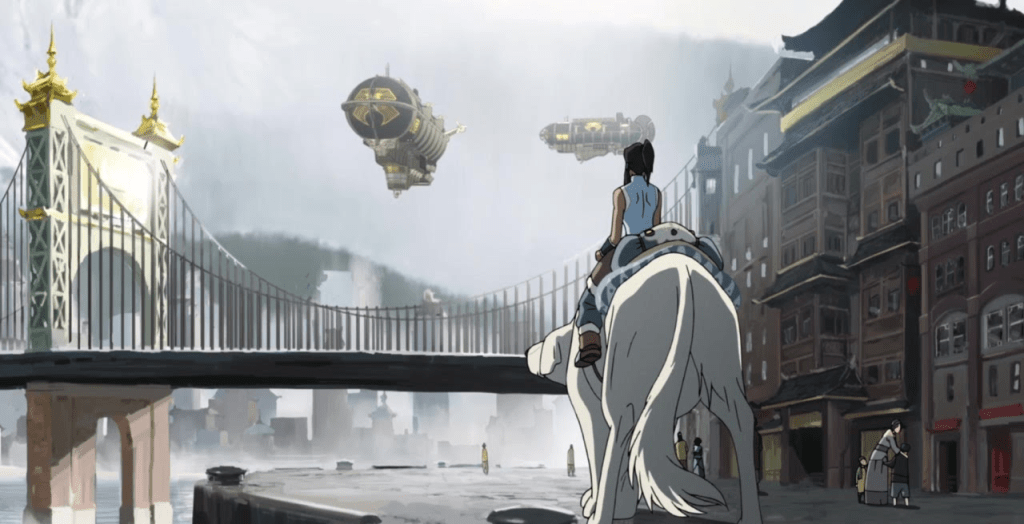
Republic City boasts a variety of technological advancements, the likes of which have never been seen before in this franchise. There are cars, airships, radio, cameras, telephones, and an overall look and aesthetic evoking New York circa 1920. There’s high-rise architecture and even a giant statue of Aang that blatantly references the Statue of Liberty.
One of the most controversial topics surrounding this show is just how realistic the technology jump is from the end of the war. It’s a tough buy for me. I talked about it extensively on my podcast, and even well after. So let’s do this. I’m going to talk here about why Republic City in incongruous with the world it’s based in.
There are some that argue that the jump in technology makes perfect sense, being that in a world where people possess bending abilities, technology would naturally progress faster than it would in our world.
I argue that the opposite is true.
It was my understanding, as a layman, that technology always advances out of necessity. The presence of bending in this world makes life really convenient in a lot of areas, and so there would be a much slower progression in technology in this world. A lot of conveniences in the four nations are based around bending, as they should be. The mail system in Omashu is powered by earthbending, as are the trains in Ba Sing Se. The Northern Water Tribe features canal waterways powered by waterbending. Even the Air Nomads had their staff/gliders as well doors that could only be opened with airbending.
The Fire Nation had an industrial revolution, sure, but they were a militaristic nation in a war for world conquest. And even their tech was built with firebending in mind (steam engines, hot air balloons, fireball-launching trebuchets, etc). In the rest of the world, technology has been moving from an almost glacial pace from Wan’s era, which checks out.
This was over a period of ten thousand years. So to say in less than one hundred years, we’ve bounded in technology to the point that we have cars, trains, radio, etc straight out of 1920’s America feels not only unbelievable, but really bizarre and out of place. Bear in mind that it took decades, even centuries, for most of these inventions to show up in our world, which doesn’t have magic. The blimps are about the only thing to get a pass. It’s transparent that the writers have wedged all of this in because they (Bryan Konietzko in particular) are fans of the 1920s aesthetic.
But don’t take my word for it.
(from the Wall Street Journal)
“I’ve always been a huge fan of the 1920s,” Konietzko says. “I love the Prohibition era, and I’ve done a lot of reading about it. I think it’s the most interesting point in American history. I love the clothes, the architecture, music, everything. We had already started ‘Korra’ when I heard about ‘Boardwalk Empire’ and I was just so excited-it’s my favorite show I just eat that stuff up.”
For the portion of people calling me out for using the creator’s words here after I’ve marked a principle against third-party information, I’m merely using this as an indication of the creator’s motives, not as an assessment of their work here. I already did that in the paragraphs above. The fact is, Bryke could’ve gone with 1920’s ‘Murica because it looks cool and made it congruent with the world on accident. But they didn’t. Because that’s difficult enough to do on purpose, and that just wasn’t a priority to them.
And let’s talk about that statue for a moment.
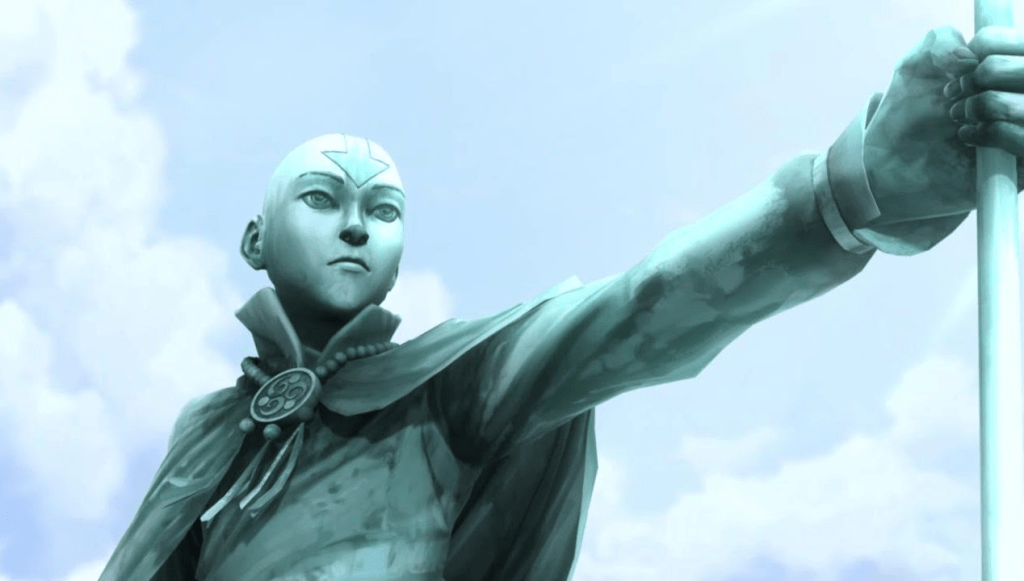
ThYou might feel differently but I find this really tacky and forced. I find it hard to believe that Aang, the simple monk, would take a page out of Ozai’s book and have a giant statue of himself commissioned. That’s really all I have to say about this thing.
So yeah, Republic City is thoroughly unbelievable as a location in the Avatar world. It very much feels like an intrusion of our world into one that felt separate and alive. And so the world of The Legend of Korra is kinda fundamentally broken and there’s no getting around that. Because Republic City isn’t a one-off location. It’s the central hub for the series. Most of it takes place in this giant, sprawling mistake.
But let’s continue with the story.
Korra sees Air Temple Island in the distance where Tenzin lives, but Naga gets hungry and so she takes Korra on some antics dodging cars (or Satomobiles as they’re called) throughout the city. Korra makes it to a street vendor where she…learns that food costs money.
I understand Korra basically grew up in captivity, but she’s familiar with a good deal about Republic City and its culture already. And anyway, do people not pay for food in the Southern Water Tribe or what? She says in a later episode that she’s never had need for money, but she at least gets there is a need for it, right?
This takes Korra to the show’s version of Central Park, where Korra is frying some fish from the lake with firebending. She’s approached by a homeless guy, who jovially welcomes her, and he essentially functions as Korra’s first exposure to the city not being quite as she thought it. As she puts it, she thought before that everyone in the city was “living it up.”
Just then, a guard chases down Korra for fishing in the lake, forcing her to flee to another part of the park. It’s here where she meets a protestor representing a group called “the Equalists.” He yells into a megaphone about how benders have treated non-benders as lower beings for centuries and Amon, leader of the Equalists, is giving the non-bending population a chance to help tear down the “bending establishment” should they choose to join him.
Now this is interesting stuff. For the first time in this franchise, a character in-universe is proposing that benders be taken down a peg. And you know what? They might have a point. After all, the Hundred Year War was started and perpetuated by firebenders. In fact, almost every major conflict in this universe has been rooted in benders. There’s even precedent in the original series for discrimination against non-benders. Toph takes the piss out of Sokka regularly for not having bending. A deconstruction of the Avatar world like this might be the way to go for a sequel. We’ve been shown already that there’s something of a wealth disparity in Republic City. Could it be that benders get privileges over non-benders? Personally, I can’t wait to get more on this.
Korra’s dialogue in this scene is indicative of what’s probably the most compelling part of our new protagonist (at least this season), and that is the amount of stake she puts in her identity as the Avatar, particularly her bending abilities. She tells the protestor he doesn’t know what he’s talking about because “bending is the coolest thing in the world.” The protestor then sets Korra up by asking if she’d like to hit him with waterbending. Korra falls for it, saying “I’m certainly thinking about it!” Korra, in her sheltered ignorance to how anyone might feel without the power to bend even one element, let alone all four, is tricked into proving the protestor right about benders. Korra has a character flaw! It remains to be seen how the season will capitalize on this, but it’s doing well so far setting up its villains as a mirror to her. If there are benders like Korra in Republic City, maybe the Equalists are somewhat justified.
Korra, with the crowd now against her after getting caught in the trap, can only clumsily tell them they’re “oppressing themselves,” (Protestor: “That didn’t even make sense!”) and walk off in an attempt to save face. Korra asks a woman where Air Temple Island is, and just then, in a shocking coincidence, a car belonging to the Triple Threat Triad rolls in.
How likely is it that the gang would roll in at this specific street, and at this specific time? Well, the area is in their territory so Korra probably would have run into them sooner or later. But we’re going to learn that they weren’t just patrolling; they were coming to a specific shop in this area to collect. At the exact time Korra is in the same area. On the contrivance scale it hits about ehhhh 40%. We can give it a pass…this time.
The Triple Threat Triad, as the name implies, consists of a waterbender, earthbender, and firebender. In what I’m sure is meant to be a clear example of benders taking advantage of non-benders, Korra sees the Triad extorting a struggling shopkeeper under the threat of burning down his store. Korra then appears and challenges them to a three-on-one. Korra’s stunted development from her lack of worldly experience has given her an almost childlike understanding of what the Avatar’s duty is. She sees it as an opportunity to play a superhero who takes out the bad guys. She showboats and makes quips at their expense. She calls the talkative triad member a “hoodlum” and tells the three of them that they’ll need a hospital when she’s done with them. She’s obviously excited at the prospect of a fight and this has taken priority over helping the civilian.
So we get out first full fight scene and not only is the animation pretty to look at, but the fight itself communicates pretty well the clear distinction in the way bending styles have diverged and the benefits of Korra’s training. The Triad clearly favors raw power and speed over skill because they primarily use bending as a means of intimidation, so Korra is able to counter their moves pretty easily. Notably, she uses the same firebending motion to leap through the flames as she does in the training scene from earlier in the episode. All three triad members are taken out, and it ends with Korra using her own physical strength to throw one into the window of another shop. The triad tries to escape in their Satomobile, but Korra uses earthbending throw the vehicle into another shop. Another show of Korra clearly using this as an outlet for her strength and powers, rather than helping people.
We then get our first look at the police of Republic City. Out of a giant airship comes a small squad of men decked out in metal suits travering via metal cables. Korra makes a remark telling us what they are: metalbenders.
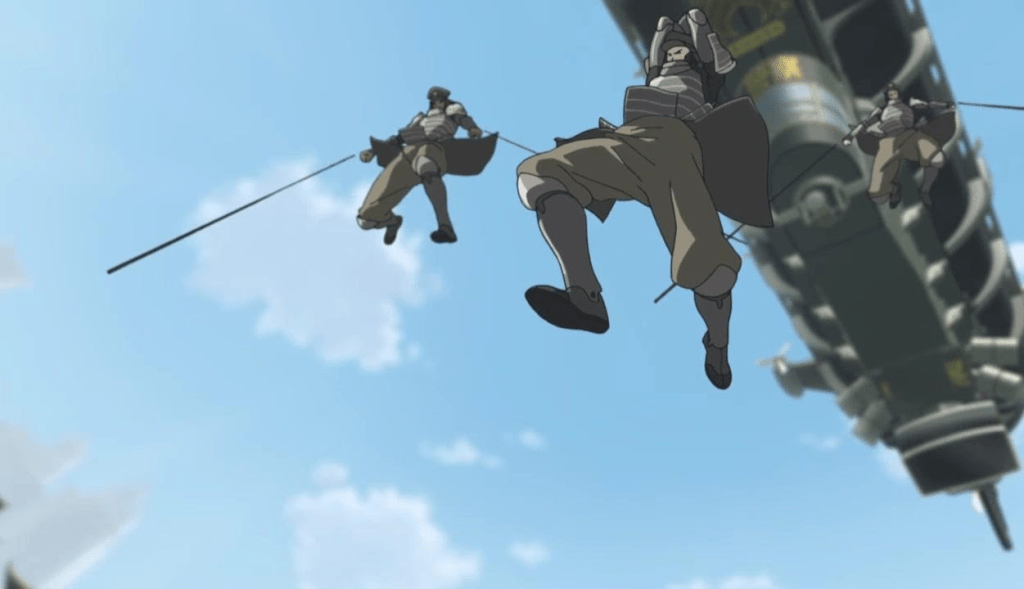
The designs for the metalbending police are pretty damn cool and well thought-out. Their uniforms have spools in the back housing the metal wires. These wires come out of gauntlets on the wrists allowing them to immobilize criminals as well as travel quickly…kinda like Spider-Man! They’re also able to grind across power lines already put up in the city.
But uhh…wasn’t the reason Toph discovered metalbending because of her unique and highly attuned senses allowing her to detect the unrefined earth in the metal? You’re telling me in 70 years enough people learned how to do that to fill an entire police force? How? Why? Like the sky bison from earlier, we don’t get an answer. The writers wanted more metalbenders, and so here we are. The worldbuilding takes yet another hit.
Korra proudly presents the “bad guys” she caught to the police, but is incredulous to learn that she’s under arrest too for the property damaged she’s caused. Korra likely believes that being the Avatar puts her above the law. She caught the real criminals, after all. Why is she being treated like one too?
So Korra runs from the police on Naga in some more City Escape shenanigans. She catches sight of Air Temple island, but just as it seems she’s lost them. She and Naga are both tied up with metal and hauled off to headquarters.
At headquarters we’re introduced to the chief of police and another descendant of the original Gaang, Toph’s daughter Lin Beifong. Lin reads Korra her charges and tells her in response to Korra pulling the “I’m the Avatar, you gotta deal with it” card that her title means nothing to her. Korra, upon learning exactly who Lin is, tries to use the relationship Aang had with her mother as leverage.
We’ve spent quite a bit of time with Korra so far, and as has been documented, she’s cumulated a number of traits and not a lot of them are good. She’s impatient, compulsive, self-centered, and thinks her status as the Avatar should earn her special privileges. The best I can say about her so far is she has some sense of justice, but even this is undermined by her need to show off. This isn’t a problem…yet. The protagonist, even a heroic one, doesn’t need to be a paragon, and certainly not right away. That’s what the series is for. It”ll be up for Korra to outgrow these traits and come into her own as the Avatar.
Lin shoots down Korra’s attempt to get on her good side, dismissing Aang and Toph’s friendship as “ancient history”, and rightfully tells her that she can’t play vigilante in her city. Tenzin arrives, having been called in, and tries to sweet-talk Lin. Lin’s response is terse and aggressive, indicating a history between the two that will be explored later. Tenzin elects to take full responsibility for Korra’s charges and cover all the damages, while promising Lin that Korra will leave for the South Pole immediately.
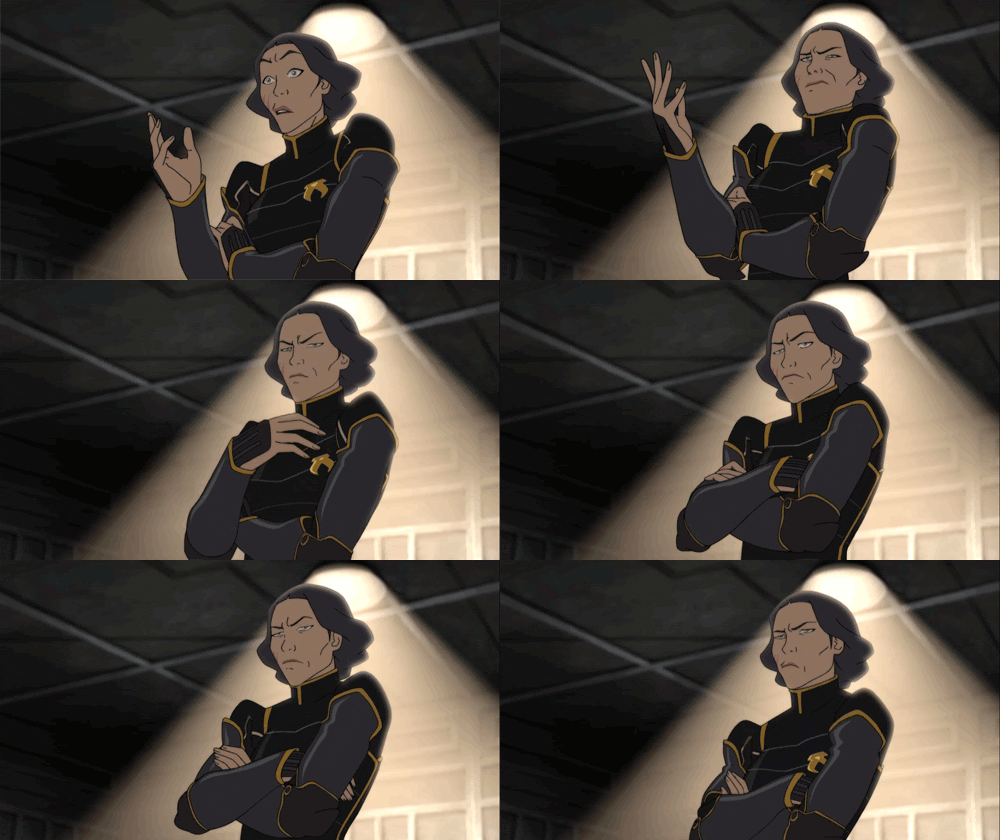
What follows is a humorous exchange I think is funny and lands pretty well. As Korra leaves, she and Lin glare at each other and Lin gives the “I’m watching you” gesture to Korra. Korra, indignant, returns a more exaggerated and mocking version of the gesture before quickly following Tenzin out with her shoulders squared and head held up. Lin quickly puts a hand up with a face that very clearly says “Wtf?” I think this joke is clever by virtue of being communicated purely through facial expressions and body language. In response to Lin non-verbally telling her she’s watching her, Korra instinctively feels a need to one-up her and can think of nothing better than to give a “No, you” response and mock the gesture she just made (It’s even funnier when you consider there’s a good chance Korra doesn’t even know what it means). She then speeds up on her way out so she can have the last word and effectively “win” the exchange. The expression Lin makes is very relatable in that it’s a natural reaction to a comeback that doesn’t make sense. And this is all exaggerated in a comical way that the animation medium is uniquely suited for. Good stuff!
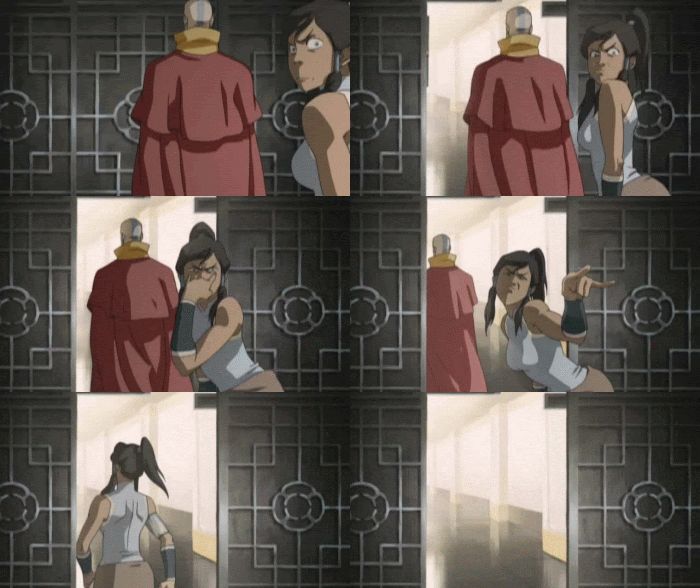
Outside, Korra begs Tenzin to let her stay in Republic City. She says what she’s seen today of the city is “way out of whack” and that it needs its Avatar just as it needs him. There’s an meme face here too that I think doesn’t land quite as well, especially so soon after the last one. Korra cites Katara telling her her destiny is in Republic City as a reason she should be allowed to stay. In response to this, Tenzin’s face turns cartoonishly red and his lip syncing animation grows exaggerated with spittle coming out as he says “Don’t bring my mother into this!”
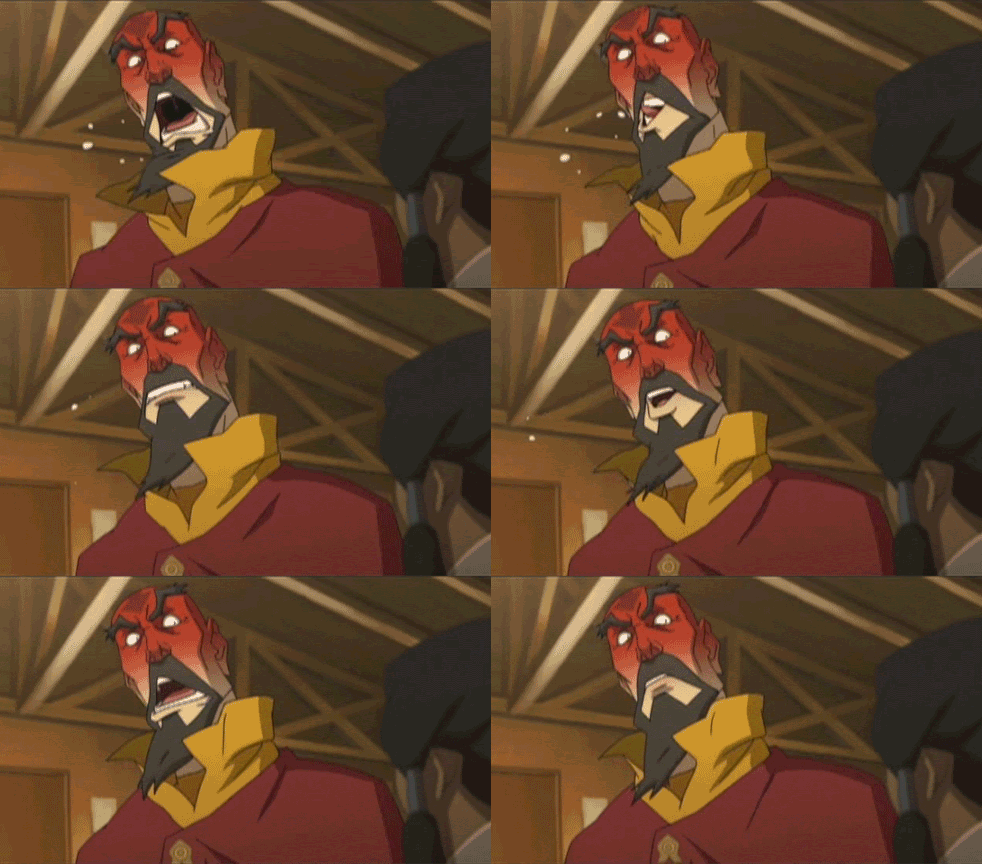
The problem isn’t Tenzin’s reaction per se, it’s that it’s paired with such a cartoony expression before going back to normal. Not only does it clash with the tone of the scene, but JK Simmons’ delivery is…fairly tame? It doesn’t match this over-the-top expression Tenzin is making. He probably should’ve channeled Cave Johnson or J. Jonah Jameson here.
Anyway, Tenzin takes Korra’s words into consideration on their way to Air Temple Island. There is a boat housing three unhappy White Lotus members. Korra is greeted by Tenzin’s kids who excitedly ask if she’s staying on the island. The heartbroken looks they give her when Korra breaks the bad news gives Tenzin a change of heart. He tells Korra that he felt like he needed to put off her training to uphold his father’s legacy, but he realizes Korra herself if Aang’s legacy. I appreciate the reason Tenzin comes to for allowing Korra to stay, especially when he says the city needs its Avatar once more. Aang had a dream for Republic City and Tenzin felt responsible for upholding that dream. In that time, the city’s come to a point of civil unrest. In Korra is the potential to heal and breathe new life into the idea of creating a city of peace. On top of that, Aang’s grandchildren represent his legacy in a much more literal sense. They clearly like Korra and perhaps there are some things they can learn from her, and her from them. Korra gathers all of them in a big ol’ hug and Tenzin has a humorous expression that says “I hope I don’t end up regretting this.”
We cut to Korra up on a podium announcing her arriving in Republic City on live broadcast. Many reporters ask the Avatar what she plans to do about the traids and the Equalists and whether or not she’ll be working with the police. Korra, in a moment I find endearing, states that she’s still in training and so doesn’t exactly have a plan yet but she’ll do her best to make Republic City a better place. And everyone cheers! Next to Korra is Tenzin and Lin. Last time we saw her, she was adament that Korra leaves “her city.” I guess she also had a change of heart?
Elsewhere we see a masked individual listening to the broadcast on the radio.
This is Amon, leader of the Equalists and the main antagonist for the season.
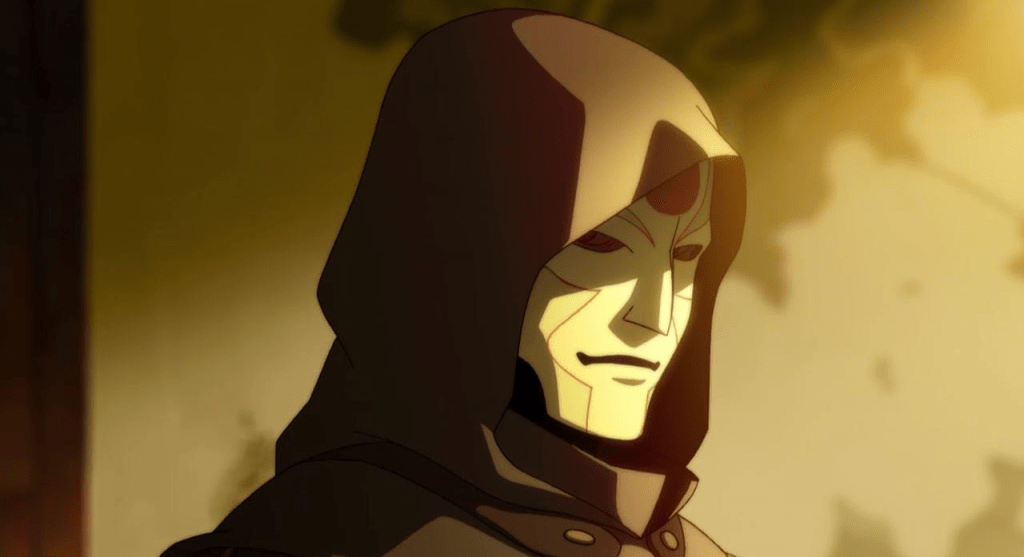
We can talk about him as the season progresses. For now, he leaves a strong impression on the viewer with a face completely obscured by design and a deep vocal performance by Steve Blum. He tells his lieutenant that because of the Avatar’s early arrival, they’ll have to “accelerate their plans.” So Amon’s plans seem to hinge on Korra. Lucky for him that she arrived when she did, eh?
And that is where the episode concludes. I’d say “Welcome to Republic City” is quite the double-edged sword as far as pilot episodes go. One hand, it does quite a fine job introducing our new characters and setting up the plot for the season. But on the other, it introduces a host of Korra’s worldbuilding issues too. The good and bad have both given me a lot to talk about. This is probably the most I’ve written about a piece of media relative to its length.
I will see you guys next time when Korra begins her airbending training in “A Leaf in the Wind”.
 Ibrahim Noir
Leave a comment