
Legend of Korra
Book 1: Air
We’ve talked about Book 1 episode by episode. Now It’s time to assess the season as a whole.
WORLD (BROKEN BENDING, TECHNOLOGY, REPUBLIC CITY)
When I described the worldbuilding in “Beginnings”, the word I used was “reckless.” And as much as I think those episodes are the worst in terms of sheer concentrated damage to the lore, I’d forgotten and thus underestimated just how much the rest of the series, Book One in particular, steamrolls over Avatar‘s universal rules.
Let’s start with bending.
Bending has fundamentally changed in the current era, being simplified and reduced to punches and kicks. This is certainly easier for the animators, but how is it justified in the story? It would seem that it’s become quicker and more precise to keep up with the hustle and bustle in Republic City, hence the style being almost a core part of pro-bending. Tenzin even laments the fact that the “traditional art” has been reduced like this. It’s not a problem for the style of bending to change this way to match its environment (however well-supported said environment is), but this extends to the spiritually-principled White Lotus, who’ve basically been reduced to foot soldiers. They chastise Korra for focusing purely on the physical side of bending, but we’re given no indication that they tried to teach her any other. As far as we can tell, her firebending test consists purely of combat. And indeed, when we see the White Lotus in action, they engage in the same “combat-ready” bending style as the rest of the cast.
The bending type the Avatar struggles with the most has subtly shifted from their natural opposite to the one opposite to them in personality. It’s a small but not insignificant change made to facilitate a reverse of Last Airbender‘s objective of teaching Aang the four elements starting with air. The Avatar journey has been done away with as well with no fanfare or proper explanation given. Remember, the reason Korra was trained in a compound hasn’t been invented yet. And these changes were made seemingly because there was no other option besides retreading the plot of Avatar: The Last Airbender. (Never mind that an Avatar struggling to bend their own element hasn’t been done before and is interesting as fuck.)
But this is all just in reference to bending as a whole. This is before we get into the bending sub-types, which have been horribly butchered in this series.
Lightning-bending has been decidedly neutered to the point where it’s functionally indistinguishable from regular firebending, while being just as easy to perform, enabling good ol’ “ha-cha-cha!” point-and-shoot lightning. Of course, this sits comfortably next to every firebender and their grandmother being able to bend lightning. Remember when lightning was, well, lightning and it was treated very seriously because our squishy human bodies are made up of water and thus conduct electricity very easily? Now getting chock filled with lightning has the same effect as getting tased. There’s no indication that it requires a different mindset or even training. Zuko had motherfucking Iroh for a teacher and couldn’t get further than popping explosions in front of his face. It’s just another part if your average firebender’s tool-kit now. Woo-hoo.
By the same token, metalbending, thought to be impossible until one girl figured out how thanks to her innate abilities, has also become so widespread and yet the best you can do with the ability is…become a cop. The show also fails to understand that seismic sense is the entire reason Toph learned to bend metal, and is thus a prerequisite for the ability. Yet apparently Lin is the only one left with the ability (other than her sister, Aiwei, and Toph herself) and still walks around wearing metal heels of all things alongside the rest of the force, who should all be walking around barefoot so they can have geo-radar at all times. Another important facet to metalbending was that it necessarily required contact with the metal, making it very crude in practice compared to regular earthbending. The comics and Legend of Korra quietly do away with this so every metalbender can be Magneto and bend metal telekinetically, firing metal strips and cables with just a flick of the wrist. Book 3 will double down on this, telling us that it only requires “focus” on the earth impurities inside the metal. I kind of commend the addition of platinum as a cap to metalbending, but the fact that a cap like this is needed in the first place should indicate how ridiculously broken metalbending has become. The writers now have this special, un-bendable metal they can pull out of the whatever aether the stuff comes from whenever they need to account for the numerous, remote metalbenders that they created, culminating in a ridiculous giant robot made of the stuff to serve as the final boss for the series. How are the tanks, armor, guns, planes, and other machines of war this show pulls out supposed to be impressive when everybody can metalbend? It’s embarrassing that more thought didn’t go into this world and how it might evolve to accomodate this.
Bloodbending’s pretty much been cracked wide open too. It can be done without a full-moon, or movement if you’re “highly-skilled” enough. That’s right, Avatar now has the Force, except not even because even the Force requires hand movements. It’s just telekineses. Oh, and all of this can be taught by the way. And if you’re particularly gifted, you can learn the ability to remove bending altogether, on the same level as energybending. How, you may ask?
[Mike] No logic!
(I’m going to hold onto this quote for a very long time.)
Some bullshit expalanation about closing chi pathways doesn’t mean anything if it doesn’t make it into your show, guys. Hell, it doesn’t make sense regardless. As I already went over, this was already the most broken form of bending and removing all its limitations like this was not a wise decision at all. And no, the excuse that Yakone, Tarrlok, and Amon are “special benders” does not save this whatsoever, because the writers have worked extremely hard to make sure there is goddamn such thing as “special” in this world anymore. They’ve already democratized almost every other “special” type of bending already. What’s stopping them from inventing more of these “special benders” on the spot to cash in on a cool idea? They’re going to invent four of them in the third season, and that’ll be on top of the decision to just give a bunch of people airbending because they feel like it.
Might as well address this here since everybody bangs on this drum:
🤓☝️ “But Ibrahim! These bending sub-types were in their early stages during ATLA! It’s natural that more and more people would discover how to use these techniques and that they would evolve over the years! Don’t you know anything about history? This happens all the time in real life!”
I have a question: why does this only apply to the bending sub-types? Seriously, if we’re using the logic that lightning, metal, and bloodbending can naturally get this much easier and more powerful over a mere 70 years, why would regular bending remain so stagnant overall in the past 10,000 years? Just for fun, let’s go over all the ways every bender should be a god of their craft at this point.
- Why do benders still bother with the motions at this point? If bloodbending can be used psychically, then surely every other bending should be as well.
- Why was metal so difficult to bend for so long? Why is platinum such an issue?
- What’s taking earthbenders so long to learn to how bend the iron in people’s bones?
- Why are there so few lavabenders? Roku probably should have won his battle with the volcano. Volcanoes should be a non-issue in this world.
- Why isn’t every waterbender regularly pulling water out of plants and thin fucking air to use for battle?
- Back in Wan’s era, everybody was floating on clouds. What happened to that? Why did they invent hokey gliders to get around instead?
- Why can’t every airbender do that weird spiritual projection bullshit Jinora can do?
- Every firebender should have comet-level bending by now.
- By the end of the Hundred Year War it’s been nearly 10,000 years and only three people in the world can bend lightning? What’s taking so long guys?
- Almost every firebender should have blue fire. In fact, they should all have whatever the strongest color is.
- Surely every firebender should have perfected the art of exploding things with their mind by now?
- The Avatar should be able to control the weather, create mountains, shift continents, and cause Avenger-level hurricanes and tsunamis without the Avatar State.
- With the Avatar State, they should be able to move the planet.
Did all of that sound ridiculous to you? Because if it did, do you know what I would say back to you?
“These bending types were in their early stages during Wan’s era. It’s natural that more and more people would discover how to use these techniques and that they would evolve over the years. Don’t you know anything about history? This happens all the time in real life.”
I know it’s not nice to have your medicine fed back to you, but what I’m highlighting is the logical conclusion of this argument if we’re meant to take it seriously, and why I don’t take it seriously. It’s a cop-out to excuse these drastic worldbuilding changes in the short-term without thinking about the long-term implications. This is also the case for most arguments made in favor of the massive jump in technology. If we’re meant to attribute the Avatar world transforming from an ancient Asiatic landscape built around the idea that there exists people who can bend the four elements to America circa 1920’s in just 70 years to the fact that technology naturally “spreads and evolves over time,” then why has the world’s progress in that department been so slow since Wan’s era? It just doesn’t work, guys.
Energybending has pretty much been sapped of all the stakes involved with that process. Remember this?
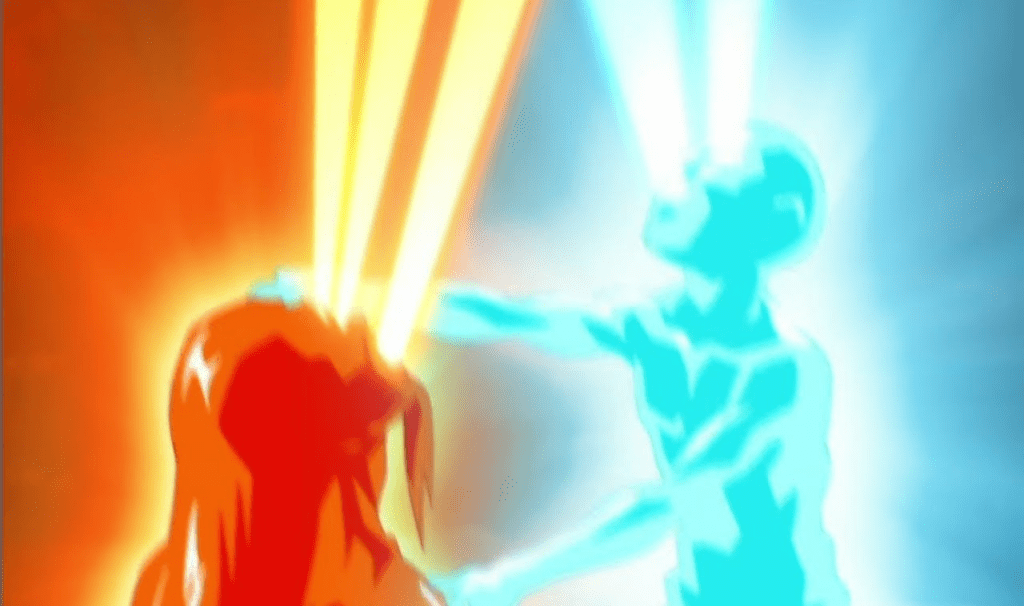
[Lion Turtle] To bend another’s energy, your own spirit must be unbendable or you will be corrupted and destroyed.
Well yeah, not anymore. The writers have just swept that little detail under the rug. Both energybending veteran Aang and novice Korra can just do it with no battle of wills or risk of corruption whatsoever. It’s literally just a “turn bending on/off” button now. Oh, and it’s completely redundant with the introduction of removing bending via bloodbending. Actually, that brings me to another point.
Riddle me this: Why wasn’t Amon just an energybender?
Look, I’m not at all happy with how energybending was introduced, and I think it damages Avatar’s finale greatly. But it is now canon, and based on the Lion Turtle’s speech, we know that energybending isn’t an Avatar-exclusive ability. Amon could have been an energybender and it would have been fair game. Imagine if Noatak, after running from his parents, turned to researching spirits to find out how to remove someone’s bending. He could’ve run into a disgruntled spirit with a grudge against the Avatar (there was no shortage of those, after all). This spirit would have given Amon energybending and the mission to destroy the Avatar and cleanse the world of bending. And since energybending is (supposedly) inherently risky if your spirit is even slightly impure or bendable, consider how much it would say about Amon’s will and dedication to his mission that he could do it so easily. I’m not particularly attached to this idea but it’s easily better than the bloodbending nonsense we got. And actually, why does Amon use the energybending stance if he isn’t energybending? He uses it whether or not any of his followers are around to see, so I have to assume it’s a requirement for the de-bending. But bloodbending never required contact with the victim, and Amon is a super bloodbender that doesn’t even need to use his hands. So what gives? Could it be that Bryke wanted us to think a certain thing before pulling the rug out from under us to reveal it was a different thing entirely? Hmmm…
But what about the elements Korra introduces?
Well, we’re told there’s a divide between benders and non-benders and this the foundation of the Equalist movement. Yet, time and time again we’re shown benders getting the shaft, with supposed rare benders of lightning and metal forced to work basic blue-collar jobs. The main proponents of the city’s crime are benders, furthering the idea that benders are lower class, not the other way around. The owners of the real businesses and enterprises are non-benders, including the richest man in the city. Despite bending lending itself to many practical and artistic endeavors, we aren’t shown any firebending glassblowers, or earthbending potters, or waterbending ice cutters. The show would have you believe the only thing benders are good for are manual labor and entertainment (which hardly makes them more money than the manual labor).
This is completely backwards. It would seem like the writers wanted to write a parallel to the Civil Rights Movement, but forgot to write a parallel to the Jim Crow era that preceded it. How can you write this way if you want us to take the idea that benders are suppressant over non-benders seriously? The only way to salvage this is for some acknowledgement of the Equalists’ hypocrisy. Not only is there none, but Tenzin admits that Republic City’s been “unstable” for some time already. And the next season has the tacit admission that there was an inherent power imbalance in having benders on the council, and choosing to have an elected non-bending President instead. Of course, nothing is said of the fact that the council is inherently unbalanced anyway, having exactly one representative for each nation when they vary so wildly in population and power, and that one council member is arbitrarily chosen to have more power over the rest. After Amon’s “defeat”, the Equalist movement all but evaporates and never has any relevance again. It’s as if the movement or the oppression of non-benders never even existed.
World: 3/10
This brings us neatly along to Korra’s “mature” themes.
THEMES
EQUALITY
I don’t know if Book One of The Legend of Korra thinks it has something to say about the concept of equality, but the fourth season will go on to pretend that each one has an “ideology” it’s centered around, so I might as well talk about it.
Well, we can’t say for certain that the character most outspoken on the concept even truly believes in it, so we’re not off to a great start. The so-called oppression of non-benders by benders is something we never see…the most charitable interpretation I can give the show is that inequality is certainly bad but you can become radicalized and go too far in an attempt to stop it. However, the show doesn’t present any alternative to extremism. Amon decides benders are the problem and tries to “equalize” the world by getting rid of them. His movement evolves into what is essentially a terrorist organization. Tarrlok counters with equally extreme measures, partaking in the exact kind of ‘oppression’ Amon keeps yammering about. There’s a lot of waxing poetic from characters like Tenzin about how “this will only further the bending divide!” but if we’re meant to believe the oppression of non-benders is real, the writers need to propose a reasonable, “correct” way of fighting it. Is it by knocking on doors? Is it through acts of civil disobedience? Is it through legislation? Is it through building power in the streets and in the communities and winning gains through mobilizing the masses? We don’t get an answer. The oppression is only ever alluded to to prop up the story, and disappears into the wind once that story is concluded.
MODERNITY VS. TRADITION
A theme that constantly comes up throughout the series is the nature of change. This manifests in Book One as the conflict between modernity vs. tradition and the pros and cons of each. Bending is more efficient but it’s less stylized/spiritually-based. The people in Republic City are not separated by their culture or ability to bend, but it’s created a powder-keg conflict between benders and non-benders (allegedly), with corrupt individuals on both sides of the divide. Non-benders have more tools and agency, but also more capability for destruction. All this being said, Book One seems to be pro-modernity. The influx of technological advancements are seen as an overall positive, outside of individuals using them for evil purposes, the integration of different kinds of people is the selling point of Republic City, and pro-bending is a celebrated pastime of the city, cited as the one thing that brings the people together. People who hang on to tradition like Tenzin and the White Lotus are consistently portrayed as being “behind the times.” Spirituality doesn’t really seem to get you far at all if you’re Avatar Korra. Meditating helps her exactly one time to learn the truth about Tarrlok and then she gets no mileage out of meditation or spirituality again. I’m not saying it’s necessarily bad that the show leans on one side over the other. That’s fine as long as it’s consistent. But we’re meant to believe Korra’s undergone some kind of spiritual growth by the end of the season when she’s done no such thing and has had no reason to. This theme comes up again in the later seasons so we can talk about it further with each one, but Book One is mostly okay here outside of Korra’s “arc.”
IDENTITY
There is a strong pattern of identity and the weight of certain identifiers. Tenzin struggles to live up to the legacy of Avatar Aang, his father. Tarrlok crafted a new identity to escape the legacy of his father, only to take the path he spent so long trying to avoid. Lin carries a responsibility to her city when she puts on her badge, and she has to shed her place as “chief of police” to do right by her city. Hiroshi puts on a fake identity as a kindly businessman in public, hiding his true nature as a bigoted and vengeful Equalist. Asami is used to being perceived as a rich and dainty daddy’s girl, and uses this to her advantage.
Now this is all and well and good, and I wanna give Korra credit where it’s due for its consistency here, but unfortunately there are two key characters who weaken this theme significantly.
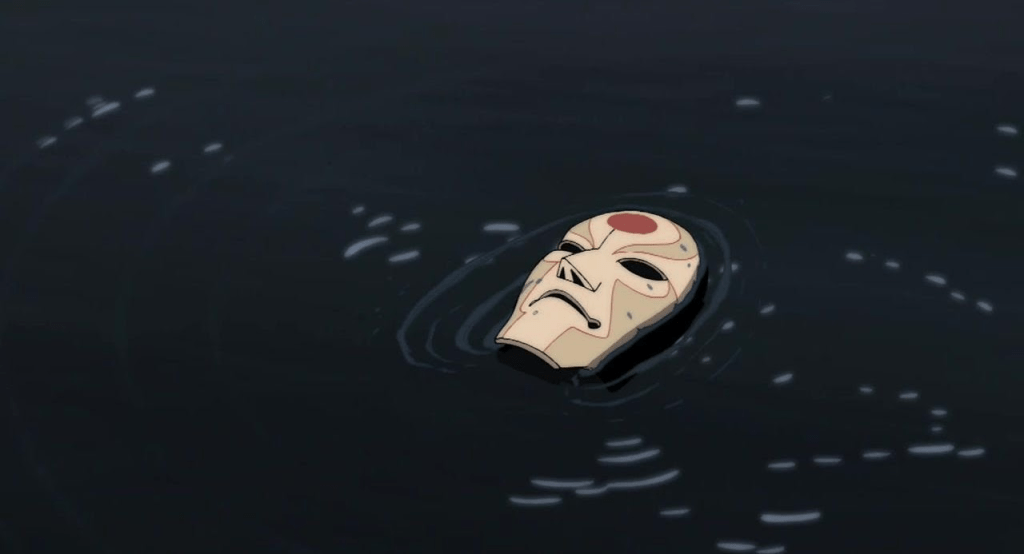
The first is Amon. Amon at first stands out in regards to identity because he is faceless by design. He is identified purely by what he represents and what he can do. The mask sheds his identity in favor of representing a collective will. But capitalizing on this theme would have required restraint, so of course it’s something the writers could not abide. Instead we fall into the complacent, paint-by-numbers storytelling trope of “Amon is a mysterious man in a mask, so he has to be unmasked at some point.” This succeeds in getting us the worst of both worlds; we’ve dismantled the character’s mystique, but at the same time there are holes in his motivation and power, so we’re left with more questions. We had a good idea of what drove Amon, but we don’t get to know what drove Noatak. More of this in his “Character” section.
The second is Korra herself. Where other characters see Korra, she sees “the Avatar.” Her first line in the show is her introducing herself as such, and Korra’s inflated sense of confidence comes from her thinking the title makes her inherently special. Her first introduction to Lin has her confused that she would be bound to the same laws and rules as your average citizen. Her identity as the Avatar is clearly important to her and tied to her self-worth. Tarrlok exploits this to get her to join her task force, and later uses it to denigrate her by calling her “half-baked”. I think it’s fair to say that Book One, and perhaps the series as a whole, is meant to be about Korra coming into her own as the Avatar. If we take this season in isolation, this is not earned whatsoever. She never approachess any spiritual growth, and the show presents the erroneous conclusion that Avatar wisdom is begotten from learning all the elements and the Avatar state, rather than the other way around. Tenzin, Korra’s mentor throughout the season, finally calls her “Avatar Korra” once she gains a bunch of new powers through no effort of her own. Korra needed to confront her identity and her relationship with being the Avatar for this arc to work. This meant deconstructing her idealized version of what the Avatar is in her head, something we were on the path of doing when she got her bending taken. But since challenging Korra in any meaningful way is horrifying as a concept to these writers, it’s undone in minutes so Korra can go back to thinking being the Avatar just means being a powerful bender. More of this in her “Character” section.
Themes: 4/10
PLOT
Way back in the beginning of the series, I highlighted the new direction Legend of Korra was taking, doing away with Avatar‘s globe-trotting plot to instead keep most of the action in Republic City. I can only assume this decision was made in an attempt to streamline the story being told. Fair enough. So what are the kind of plotlines that Book One works with in this setting?
Well there’s Korra traveling to a new city to learn airbending. This is quickly intertwined with her facing off against the Equalists. So far so good, except this is hindered by a tumorous romantic sub-plot that even comes with an entire episode dedicated to this aspect. This is precisely what not to do if your intention is to streamline your storytelling. Regardless, these are what can be considered the big three plotlines of Book One.
Now that we’ve had a brief overview, let’s get a little more granular.
Book One of The Legend of Korra has a relationship with cause-and-effect, but it’s not a good one. The show regularly takes shortcuts to get our players to where the writers want, and by the end of the season, it’s downright allergic to the concept of causality altogether. It is easily the plot’s most consistent issue. I’ve highlighted contrivances big and small from start to finish, but to go over a few:
Implausible conveniences:
- Korra meets Bolin the minute she’d need his help
- Korra is allowed to pro-bend despite being the Avatar and a last-minute addition
- The whole biz with the Equalist flyer map
- Mako looks around for ways to make money for the Ferrets and the opportunity of a lifetime literally runs into him
- The ground in Sato’s secret factory is made of earth when everything else is platinum
- Korra is not only right that Air Temple Island is currently Amon’s base, but she also runs into the best source of information she could’ve found in the attic
Implausible inconveniences:
- Korra comes across a Triple Threat shakedown on her first day
- Just as Tarrlok is about to skip town with Korra, he comes up the stairs of his basement and runs into Amon.
- The baby is about to be born just as the Equalists attack Air Temple Island
- Two Level 99 bloodbenders wreaking havoc on the same city because unbeknownst to the both of them they were brothers all along
Aspects being invented solely for the plot before being discarded:
- Cabbage Corp.
- The idea of the Council having more than two members
- The Lieutenant being in any way competent in and out of battle
And of course, some big ol’ plot-holes:
- Sato tries to depose some of the most prominent figures in Republic City despite Amon acting discreetly up to that point
- Asami makes it into the factory without anyone noticing despite not being an earthbender
- Naga’s able to carry Team Korra despite their being too heavy before
- The hobo sanctuary has telegram despite all communications being shut down.
- Naga gets past the electric fence
- Fucking everything in the latter half of this episode
Now say it with me because this is the #1 defense employed in favor of Book One’s plot:
“Korra was supposed to be a mini-series.”
I don’t care. Good mini-series exist. The argument that the season essentially had no choice but to be written poorly because it was going to be a mini-series is not something I’m looking to entertain. Bryke wasn’t locked into writing Korra with a mastery over every element except air. They weren’t locked into having her lose her abilities, necessitating that they make a quick excuse for her to gain them all back. They weren’t locked into wasting time with pro-bending and the love-triangle bullshit on top of the Equalist and airbending plotlines. They weren’t locked into putting the fucking baby in this story. Arcane’s first season is a mini-series. If you think that comparison is unfair because Arcane has a much longer length overall, I’ll instead direct you to Over the Garden Wall, another miniseries, and one that manages to tell a more coherent story with ten 11-minute episodes! The fundamental difference between both shows and Legend of Korra is that they’re written with care, a clear goal and direction, and respect for its audience’s time, three things lacking in Korra. Books Two, Three and Four have similar copes, ranging from budget cuts to network interference, all meant to excuse the show’s bungled writing, and we’ll deal with them individually as they come up. And it’s not like there’s a significant drop in quality, either. It’s just more of the same.
If we grant those excuse to the later seasons though, Book One still has the least excuse to be so sloppily-written. It would have had the most time to refine the writing. Regardless, it is incredibly weak in terms of plot and this can mainly be attributed to its over-reliance on convenience (to the point of outright disregard for continuity in later instances), and its indulgence in time-wasting nonsense, two things you can avoid no matter how “mini” your series is.
Plot: 4/10
CHARACTER
Let’s start with Tarrlok. Tarrlok is introduced as a sleazy politician only interested in the growth of his own influence and power. This is before we learn just how far he’ll go to get what he wants, from manipulation, to bribery, to aggression. He became the spitting image of his father, despite growing up a kindhearted child who didn’t relish inflicting pain onto others. He merely went the official route, aiming to control the city from the top, rather than the bottom. It takes him losing his bending to realize what he’s become. He performs a final act of atonement by taking his brother’s life and his own, understanding that they’ve hurt too many people already, and concluding that too much of their father is in them for them to have a fresh start.
All things considered, Tarrlok’s arc was okay. The fact that his backstory is thrown in at the penultimate episode sort of brings certain things into question, like how Tarrlok could claim to be better than his father while rounding up non-benders and threatening Korra with blackmail, but I suppose Tarrlok’s story could be seen as a lesson in how the road to hell can be paved with good intentions, not unlike Fire Lord Sozin. And there’s room to interpret that being the un-favorite child growing up might have given him a desire for respect and admiration, to the point of serious domination and control issues. I can barely give it a pass, but he is one of the better-handled characters this season.
Now let’s talk about Asami. When she’s introduced as Mako’s hot new girlfriend, Asami is somewhat justified in being underdeveloped. In retrospect, however, we’ve wasted valuable we should have spent learning about this character if we’re meant to go along with the fact that she’ll be part of the main cast, following what we’re meant to believe is a pivotal decision in her life. Instead, she is relegated to the bit role of being Mako’s girlfriend and stays there until the last minute, essentially. In the very episode we’re meant to bite our nails in anticipation over whether she’ll side with her father or her friends, the first and only thing we learn about her is that she’s a good driver and a good fighter which, as I said, is not a substitute for character. It was by precisely this moment we should have learned what Asami values. Is it family? Is it love? Does she desire respect, to be seen as more than “daddy’s little girl”? Any of these could have helped to inform the decision she makes but we get nothing. I made the comparison to Zuko in “The Crossroads of Destiny” and I said the reason Zuko’s decision was so compelling was that it really could have gone either way. You could make the same argument for Asami, but they’re not the same. Zuko could have gone either way because we have enough references by that point to inform either decision. Asami’s could have gone either way because we have no references to inform either decision. All we know is she cares about both her father and her friends. I hope I’m making some sense here. It’s less of a character-informed decision and more of a coin toss.
Imagine for a moment that Asami was in kahoots with her father the whole time and was just stringing Mako along. You could make her an Equalist remnant who’d be a recurring antagonist the likes of Azula to show up and ruin the heroes’ plans. If you insist on making her so ridiculously adept at fighting, you might as well let her give Korra a challenge. Give them a rivalry. Hell, you could do the “enemies to lovers” thing and have them progress from bitter enemies, to rivals, to friends, and then to more than friends as they come to respect each other more and more.
I’m not saying this is what the writers definitely should’ve done, I’m only saying it’s one direction they could’ve taken her character. Instead we’re left with a character who is doomed to be defined by her relationships with other characters. You don’t need to look further than the rest of this season. Asami is define by her resentment towards both her father and Mako. The culimination of her storyline is a brief confrontation with the former, and he gets no closure on her relationship with the latter. And for the rest of the series, she will continue to play second-fiddle to the likes of Varrick, Mako, and eventually Korra. But just within the scope of Book One, Asami isn’t particularly poorly-written, but she is severely underdeveloped to levels acceptable for bit characters, not a main character.
Mako and Bolin are more representative of archetypes than they are of characters. Like Asami, this would be forgiveable if they weren’t meant to be central characters. It’s almost insulting how flat they are, especially Mako who’s named after Iroh’s original voice actor, for God’s sake. But I suppose the end of the series will be a better time to talk about his treatment. This season establishes the brothers as a pair who grew up on the streets after a tragedy left them as the only family either had left. Mako is a chronic brooder, hardened by his past like Batman. The writers got so try-hard about this that they gave him a tragic keepsake scarf in the same vein as Katara’s necklace. He and Bolin are ass thick as thieves, so it’s all the more strange that the writers decide to pit them against each other in a weird romantic sub-plot that neither of them really win, or develop as characters following the ordeal. Mako is still a brooder but now he’s head-over-heels in love with the girl who completely disregarded the fact that he was already in a relationship. And Bolin is just a joke generator. Bolin is a particularly odd case because he has the same tragic backstory as Mako, but he’s come out of a total goofster. I’m not saying it doesn’t make sense that Bolin isn’t also a stoic brooder, but we’re not given any information to inform his cheery outlook on life. Not here or throughout the rest of the series. It comes across more like Bryke wanted to re-create a Sokka-like character for our new “Gaang”, but mistakenly thought that people liked Sokka exclusively for his goofiness. Sokka was a comic relief character for sure, but this was informed by his cynical outlook on life, growing up as a non-bending warrior in a world full of people who can control the elements. And more importantly, Sokka’s goofiness was contrasted by his other traits, namely his intelligence, shrewdness, skepticism, and strong sense of justice. Bolin has no other traits outside of “funny man”, so the shtick naturally wears out its welcome very quickly. Especially when the narrative locks him out of expressing anything that isn’t exaggerated for laughs. Similarly, Mako is just “stoic man” who becomes “stoic man who’s in love with Korra”. He’s painfully boring, and it shows in the later seasons that writers are desperate to give him something to do.
Tenzin and Lin are two of the show’s more compelling characters, thanks in no small part to the two of them consistently acting level-headed and making smart decisions. The two mirror each other in ways pertaining to the personalities and roles in the story in relation to Korra. Tenzin, being Korra’s spiritual mentor, is sympathetic as a man carrying around several identifiers, each with a significant amount of weight. He is a father, a husband, a councilman, a mentor to the Avatar, the sole airbending master, and the son of Avatar Aang. We get enough subtext to see there are traces of insecurity over that last one, enough to feel like he has a lot to live up to much like Korra. It adds an undercurrent to their relationship that might inform the difficulties in getting through to her. Lin is primarily interested in the safety and well-being of her city. She really only carries one indentifier, that of chief, but it’s clear that she sees this role to mean that she is essentially the mother of Republic City and her own men. She is less of a fan of Korra because she’s an undisciplined menace who has her own ideas of what protecting Republic City looks like. Not coincidentally, the narrative paints both Lin and Tenzin with an unsympathetic brush in regards to Korra, which is frustrating considering both of them have pretty reasonable motives. The future of the Air Nation rests squarely on Tenzin’s shoulders. Carrying on the culture in a way his father would be proud of is clearly a big deal to him, which makes it all the more frustrating when he’s treated like a stick-in-the-mud who needs to get with the times. Lin is similarly treated as a bitter old woman. I just wonder what’s the point of a mentor character if their advice is able to be routinely ignored by their mentee and that character can still get what they want. It feels entirely uneared when Tenzin tells Korra he’s proud of her in the end because she did nothing to be proud of. She, in fact, did nothing at all. The writing consistently lets Tenzin down and put him through the wringer, but this season is only the beginning in that regard. Lin, on the other hand, is treated much better by the season. The flaws with her final stand aside, it speaks to how much she cares that she would put her bending and life on the line for Tenzin’s family and Korra. It’s just a shame that her sacrifice is so casually undone by the end.
AMON
I want to talk a bit about Amon, because holy hell what an absolute fumble this character turned out to be.
Amon was just about everything you could ask for in a villain. He was intelligent, cunning, ruthless, and formidable. But Amon went further, challenging the status quo of the Avatar universe. The show might have forgotten to show us the bending discrimination in Republic City, but there is a conversation to be had about the kind of influence benders have on the world and how fair this really is. Bending gives a person an extreme amount of agency and control, and so if they’re unhappy with the way the world is, they can change it. Amon believed that that power shouldn’t belong to just one particular group of people. And with Korra lording her power over everyone on the regular, it’s made him the perfect antithesis to her. And so it’s easy enough to get behind his idea of equality, even if he’s extreme or even hypocritical about it, to an extent. Plus a non-bender being so competent a fighter that he can go toe-to-toe with any bender is just damn cool. Even better that he’s powerful enough to intimidate the Avatar.
How’s this for a hot take? I think Amon represented a “dark Avatar” far, far better than that cringe nonsense we got in Book 2. A bender of all four elements, acting on behalf of humanity to maintain balance in the world through diversity and borders, versus a non-bender uplifted to energybender acting on behalf of the spirits to enforce a different kind of balance onto the world through equality and homogeneity.
Are you seeing the vision? Do you see what we could have had?
But no.
Then came the reveal that Amon is a bloodbender.
What was once a character who got by on his own merit and competence, and very much principled against the concept of cheating, turned out to be a cheater himself, implicitly by lying to his own followers and explicitly by using bloodbending to make people miss their attacks and using his own unexplainable power to take away theirs. And it’s opened up a can of worms the writers couldn’t begin to deal with.
Why didn’t Amon bloodbend Korra and capture her when she escaped from the cabin? Why does Amon need to make a fake backstory when being the son of an abusive bloodbender works just as well? Where in the hell did Amon learn to take away bending altogether? Why did Amon create a whole-ass water cyclone to expose himself in front of everyone?
But this all sidesteps a very important, fundamental question that the writers inadvertently raised, but completely neglected to answer over the course of the season:
Why does Noatak want to rid the world of benders in the first place?
Noatak is easily one of the world’s most powerful benders, being a psychic god like his father. Tarrlok tells us he was invested in fair treatment from early childhood. This is supported by him talking back to, and eventually taking down his father for bullying Tarrlok. But then he uh…runs way…abandoning them both.
Why did you do that, Noatak? Did you just decide right then and there that bending was the root of all evil in the world and you need to purge it? I mean, way to think big I guess, but leaving your brother at the hands of your abusive megalomaniac father that you just humiliated isn’t particularly helpful to anybody. Did you decide you wanted to take out the Avatar to prove that you have the most powerful power on the planet? Is it that you resented Tarrlok’s weakness, and so you set out to equalize the world to eliminate both weakness and strength? Or did you decide to hate bending at some later, undefined point for some other, undefined reason? Do you care about your brother at all? How do you feel about the fact that you’re a bender yourself, and one with the power that could most easily be considered an unfair advantage?
How did you get from A to B, Noatak?
Your guess is as good as anyone else’s. To this day, there is no consensus on what actually brought Noatak to believe bending was the source of everything wrong with the world and crafting the Amon persona. Some fans have come up with the explanation that Noatak was only trying to escape his father’s shadow. And he does this by…fulfilling his father’s revenge fantasy of destroying the Avatar.
Right.
The truth is, the reason the character of Amon worked so well before was because he was more of an idea than a person. The man under the mask was never really important compared to what he represented. The idea of an incredibly skilled non-bending antagonist with a hatred for benders, who manipulates and entrenches the non-bending population into a self-victimizing mentality to achieve his goals was an incredibly strong concept.
The idea of an incredibly powerful bender apparently so self-loathing he wanted to take out all benders because of…daddy issues? Not as strong a concept. And the fact that it’s dropped on us in such a “Oh, and by the way” manner in the penultimate episode just makes it that much more disappointing. It feels like an afterthought that even the writers were hesitant to go through with. And it’s simply not as engaging. Amon was easy to root for because there is the implicit idea that benders do have an unfair advantage over non-benders, even if the show couldn’t be bothered to show it to us. Amon was made to feel powerless in fake, tragic past. This makes it easy to at least see where he’s coming from in his pursuit for control, even if he’s a liar and a sadist, because he’s still an underdog (at least in some measure).
Noatak though, as it turns out, has all the power in the world but apparently also has so much pent-up steam to blow off and it doesn’t really matter where. And so he throws this ginormous temper-tantrum in the form of a full-scale terrorist occupation of Republic City.
🤓☝️ “But Ibrahim! Amon’s mask had to come off some time. If he was exactly what was said on the tin, it would’ve been boring.”
Come the fuck on guys. Is that where the bar is? Do we really need to have a last-minute twist so badly that any old mediocre twist will do? Where are our standards?
Amon was a great villain from the start, and there was never any need to unmask him at all. The mask was a symbol. A representation of everything he stood for (twisted his beliefs may have been). Was anyone sitting through The Dark Knight waiting for Batman to scrub the makeup off Joker’s face so we could see who he really was? I didn’t think so. What the Joker represented, especially in contrast to Batman, was what made him such a memorable villain: anarchy and the barbaric, unrepentant nature of man, among other things. Darth Vader is memorable for similar reasons. It didn’t matter (at the time) who he was under the helmet. What mattered was that he was everything Luke Skywalker needed to overcome to become a Jedi Knight and save the galaxy. You don’t need to watch the prequels for Vader to be compelling. This same pricniple applies to Fire Lord Ozai and it’s what made him work so well despite being pretty one-dimensional himself.
Like the examples above, Amon held up a mirror to Korra. Benders as a whole might not have been keeping non-benders at heel, but they certainly had the potential to. And Korra’s disrespectful and prideful attitude, particularly in relation to being a bender, reflected that potential. In fact, it would’ve been plenty nice and thematically relevant to have both a bending and non-bending antagonist in the form of Amon and Tarrlok so we could explore to evils of both sides of the bending divide, with plenty of shades of grey in between. It was the one thing Bryke got right in the season so far, but God forbid this show have any kind of restraint.
So they turned him into a guy in a mask…who wears makeup.
KORRA
Last but not least, our very own Avatar Korra.
Korra is introduced to us as a child who’s fierce, independent, and always ready for a fight. We then cut to an adult Korra who’s very much the same in demeanor. We’re told she excels at the “physical side” of bending but continually neglects the “spiritual side”. Whatever this is supposed to mean, it’s to be understood that it’s held Korra back from learning airbending. This is hard to buy when freedom is the core principle behind airbending and Korra is very much attuned to that aspect. She very clearly wants to be free to explore the world outside her compound as early as the first episode. It’s change and adaptability that she has trouble with…despite being a waterbender. The best interpretation I can come up for why Korra has trouble with air and not water is that air promotes flexibility, detachment, and following the path of least resistance, things that Korra actually does have trouble with.
Despite this “limitation,” she revels in her role as the Avatar, her sheltered upbringing leading her to treat the role as a sort of superhero, with her bending being her superpower. Without it, she’s nothing. This is what directly informs her fear of Amon. Only after she admits her fear, the show leaves it on the table without developing it further. Every other time after “A Voice in the Night,” she seems pretty ready to face Amon. The writers of this show simply can’t allow this to become something Korra has to work on to overcome because they are allergic to the idea that she has anything to work on. I’m sorry, but some close-up shots of Korra sweating isn’t substantive character work. Even if we considered it so, it’s still inconsistent at best. The nail in the coffin, though, is that once this fear is realized and Korra has her bending taken, there was a clear and interesting road to take her character that was decidedly not taken.
Imagine if the writers had the balls to make the de-bending stick and Korra had to find her way as the Avatar without the ability to bend outside of airbending. She could reflect on the consequences of her own impulsive actions, rushing in without a plan and paying the ultimate price for it. We could’ve seen her work to gain access to water, earth, and fire back, bringing back an aspect of the original show that was missed this time around, but with a new twist. Bringing this character down several pegs was precisely the direction to take this person who, by her own admission, has become so used to having things handed to her all her life. What better place to bring a character who’s overly involved with the physical side of bending, but neglectful of the spiritual side, than to remove the physical ability to bend altogether? We could’ve had Korra re-learn the elements the “right way” where she grows more appreciative of the “spiritual side of bending” this show claims she has none for, all the while watching her grow into a more spiritually-minded and humble person.
I would have thought that the moment she airbends for the first time, at the very least, would have necessitated some change in her character…but it doesn’t. And you need look no further than her first gust of air being a punch, showing that Korra is still the same character who brute-forces her way through all her problems that she was at the start of the series. Korra apparently took to water, earth, and fire like a duck to water, and we’ve been told throughout this whole season that she can’t airbend because it’s incompatible with her personality. It’s the most straightforward setup for character development, and then she learns it…without changing her personality at all. It’s wild to me that Legend of Korra, in an entire season, could flop so hard at a task Avatar aced in one episode. Aang always had the reflexes and skill to stop the rock. His problem was his avoidant mindset. It took the events of the day (and Toph pushing his buttons) to finally get him to start thinking like an earthbender, rooting himself in a motivation to protect what he loves in the face of danger, first Sokka from the sabertooth moose lion and then his staff from Toph. Korra finally airbends because…she was so afraid and desperate at the idea of Mako losing her bending that she just forces it out. No change in mindset or spirituality or anything.
Instead, “spirituality” is given to her in a ZIP file by Aang, along with her bending, energybending, and the Avatar State to boot. She’s rewarded with even more powers than when she started. The Avatar State is particularly egregious because she’s apparently gained immediate mastery over it, something that taken most Avatars years to master even after mastering the elements. The gravity and ramifications of this power have been completely forgotten by the writers, evidenced by the first scene of the next season playing it off for a joke.
Korra was broken, and got magically fixed. And the only explanation we get is that “when we reach our lowest point, we are open to the greatest change,” a nothing-statement meant to hand-wave the bullshit at play here. I’m sure the interpretation is meant to be along the lines of “when you reach rock bottom, you have nowhere to go but up,” which is true to an extent, but in this context it’s completely meaningless. A key component of this adage is that you ultimately have to choose to make that climb and work your way up. You aren’t given a magic carpet ride up to the top. The obvious parallel is Yakone. He was brought to his lowest point after having his bending taken, and given the same opportunity to undergo a great change. Did he do anything of the sort? No. Even in the new life he led, he doubled-down in his fixation on revenge and arguably became even more single-minded, trying to live the life he couldn’t let go of vicariously through his sons and robbing them of any purpose in life they would’ve chosen for themselves. In contrast, the other parallel is Tarrlok, who chose to change once he lost his bending and realized his father’s legacy had infected him and his brother. Korra didn’t make any sort of choice when she was brought to her lowest point other than to run away and cry. And Korra post-“greatest change” isn’t meaningfully different than Korra pre-change. What exactly was Korra’s “greatest change” outside of just getting more superpowers?
I’ll tell you what it should have been for a reward of this size to feel earned. Korra said things would never be fine again after she lost her bending, and that she wasn’t the Avatar anymore. She defined herself by the ability. She believed she must be a bender to have any value whatsoever as the Avatar and as a person. It was this attitude that needed to change. But once her bending is restored, she reconnects with everyone and is 100% fine, learning nothing from this whole experience. She never recognizes the failing in defining herself solely by her bending. She never learns that she has value beyond her bending. She gets to go on thinking that she lost all worth for a minute, but then got it back. This is dangerously negligent writing, because I don’t think that’s a message Bryke would ever intend viewers to walk away with. But in their rush for a happy ending, they plunged the message into a black hole. This is like if the Beast from Beauty and the Beast just got to become human again after crying about how unfair it is for the witch to take his human form away. There’s a very good reason why no version of the fairy tale plays out this way.
The restoration of Korra’s bending should have been a long, long journey, and it needed to start with her facing the reality of what happened, and coming to accept it. She needed to see that she still had worth. She needed to rise above the idea that she was “nothing” like her nightmare version of Amon told her she was. She needed to willingly choose to be “Avatar Korra”, despite her new position. She needed to separate her spirit from her body to achieve spiritual enlightenment, so that the spirituality this show claims she lacks can be of some consequence.
Some of y’all bout to be real mad at me. But it must be said.
Korra is a Mary Sue.
I know that’s contentious and I’m sure many of you take issue with the term alone. But I’m gonna ask that you guys let me cook on this one.
I understand the term “Mary Sue” is thrown around a lot these days, to the point that its definition has gotten so nebulous that no one can agree what exactly what its qualifiers are. It’s used to mean everything from “character I don’t like” to “self-insert” to “overly-idealized character” to “power fantasy” to “character who gets too much attention” to even just “female character.” For the purposes of this review, Korra being a Mary Sue is exclusively to do with her being poorly-written. If you’re that uncomfortable with the term, just mentally replace “Mary Sue” with “poorly-written character.”
Some of the most commonly agreed upon Mary Sue traits are:
- Having little to no personality outside of being altruistic
- Having no story-relevant flaws
- Having a dramatic, tragic backstory that doesn’t affect them in any way beyond the superficial
- Being inexplicably overpowered
- Being exceptionally rare in terms of power or looks
- Having the plot hinge upon them in some way
- Being seemingly incapable of doing wrong
- Being instantly likeable or intriguing to characters good and bad, with anyone disliking them portrayed as unsympathetic
- If they’re introduced into an established setting, being better than established characters in most ways
- Receiving with ease what other characters normally have to work for
- Being unable to die unless as part of some grandiose, heroic sacrifice that saves everyone
This list is far from comprehensive, and there’s no clear number of “boxes ticked” until a character has enough traits to be considered a Mary Sue, which is what makes this conversation so complicated. Generally, it’s going to be less the presence of one or two of these traits, and more the combination of several of them being utilized to “protect” a character, narratively-speaking.
The point being, a lot of these do apply to Korra, and I’m going to go over them.
Korra casually mistreats just about everyone around her, but will never get called out on it. Mako takes the brunt of the blowback over his kiss with Korra from Bolin and Asami, despite her being the one to initiate it. Bolin holds no hard feelings over the girl who played with his feelings, and Asami seemingly holds no grudge over her disrespecting her relationship with Mako (in fact, they’re going to become besties and more in the latter half of the series). Everyone who doesn’t like her way of doing things will be humbled and put in their place until they’re pro-Korra because she’s the Avatar, and you gotta deal with it. Indeed, Mako, Lin, and Tarrlok all come around to Korra during the series and are each portrayed as more sympathetic once they do so. Hell, Mako is head-over-heels for her by the end of the season.
When she’s faced with rules and authority figures who would prevent her from doing what she wants to do, she rolls right through them. Tenzin telling Korra she needs to get her mind off pro-bending so she can learn how to airbend? Turns out pro-bending is how she starts to learn how to airbend. Korra joins the Fire Ferrets mid-championship and bends multiple elements during the match? Not only is she not disqualified, but she’s allowed to play despite being the Avatar. Tarrlok aggressively tries to kill her? She can overpower him by even more aggressively trying to kill him, and she faces no consequence for trying to intimidate and kill a councilman (crazy bloodbender notwithstanding).
Her “flaws” are stubborness that never come back to bite her, impulsiveness that never results in her making a incorrigible mistake, a bad temper that gives her an excuse to lay the smackdown on her enemies and detractors (all of whom deserve it of course), tactlessness that’s only portrayed as “speaking her mind”, and a self-pitying attitude that results in her getting exactly what she wants and more.
Most Mary Sues are unbelievable character with unfathomable likability. This does not describe Korra. Korra is an unbelievable character with unfathomable dislikability, and yet people like her anyway.
But for me though, the moment that Korra getting her airbending, her other three types of bending back, full control over the Avatar State, and energybending all at once cements this, and is a perfect representation of the fundamental problem with this character: Korra doesn’t have to work for anything, or overcome any of her problems. Korra training in the compound her whole life is inconsequential, because she can bend with the best of them, anyway. Korra not having the patience to learn airbending Tenzin’s way is inconsequential, because her way turns out to be the correct way all along. Korra failing to adapt any of airbending’s principles is inconsequential, because the ability just “unlocks” within her at a climactic moment, and she doesn’t even need to adapt to its principles. The fact that Korra isn’t spiritually-attuned is inconsequential, because Aang comes to her at her lowest point. Korra being impulsive and hot-headed is inconsequential, because her gut turns out to be right, and when it isn’t, she gets a lucky break anyway. Korra losing her bending is inconsequential, because Aang just shows up to give it all back to her. The fact that she let Amon get away is inconsequential, because Tarrlok murder-suicides them both. Anything not going Korra’s way is inconsequential, because all she has to do is sit and cry and her problems will solve themselves. How can anyone be expected to connect to a character like this?
🤓☝️ “Zuko has the same personality flaws and you sing his praises. You’re just like the rest of them, Ibrahim; you just hate Korra because she’s a woman.”
It’s true that Zuko was prone to acting like a little bitch throughout the series, especially in the early half. He was temperamental, hot-headed, whiny, and sullen. But you know what? Zuko was a teenager with a lot of pressure put on him. He was reluctant to connect with people and prone to lashing out at them because he’d gotten so used to people he cared about having turned on him. And more importantly, do you remember what would usually happen following instances where he acted this way? He’d be called out and humbled in some way, and made to feel things like guilt and remorse.
Meanwhile, Korra is not going on an Avatar journey and her only difficulties are not picking up airbending as quickly as others, boys, and the possibility that she might lose her bending not get to play Avatar for a while. Everyone likes or will grow to like her despite her temperamental attitude, and she is, again, by her own admission, used to being handed things. She has everything she needs to succeed, and yet she gets just as pouty as Prince Pouty Zuko from Book One. Nobody calls her out or humbles her, and I have no idea if guilt and remorse are concepts she is even familiar with.
Wow. So much pressure.
Korra is the product of Bryke wanting a badass female protagonist, without knowing how to write one. I don’t know how she can be championed as an example of strong female writing when the moral of her story is essentially, “If you are a woman with functioning tear ducts, you don’t have to do a damn thing.” The ladies deserve better, I think. Fans will defend Korra by saying that she gets better in the later seasons. Believe me. I am looking forward to showing you how wrong they are.
Character: 3/10
OVERALL
So yeah, Book One of Legend of Korra isn’t very good. It’s principle problems are its approach to worldbuilding, its plot, and it’s principal characters, and these are not great problems to have, especially as a foundation to the rest of the series. Because that’s the real kicker, folks. Book One is still the best out the four. Almost all its problems plague the rest of the series, and Books Two, Three, and Four are going to build off of this shitty foundation to commit their own atrocities against this franchise.
Are you excited? I’m not.
 Ibrahim Noir
Leave a comment